
Buy more, save more
- 3–5 rolls 3% off
- 6–9 rolls 6% off
- 10–19 rolls 10% off
- 20+ rolls 15% off
Discount is applied automatically in your cart.
Ultra TPU-95A High Flow
$26.95
1.75 mm diameter · 1 kg net filament per spool
Ultra TPU-95A High Flow prints genuinely flexible, rubber-like parts — phone cases, seals, bumpers and grips that bend, stretch and bounce back — tuned to print faster than flexibles traditionally allow.
Printing & drying
- Material
- TPU 95A
- Diameter
- 1.75 mm
- Spool
- 1 kg net
- Nozzle
- 200–230°C
- Bed
- 30–45°C
- Printing speed
- < 200 mm/s
- Part cooling
- Low
- Enclosure
- Not required
- Nozzle type
- Standard brass
- Extruder
- Direct drive strongly preferred
- Drying
- 70 ± 5°C
These are typical working ranges for orientation. The label on the spool you receive is authoritative for that batch. More detail in the storage and drying guide and the troubleshooting guide.
Shipping
- Packed and dispatched from Sydney, Australia.
- Every spool ships sealed with desiccant.
- Tracking is provided on every order.
- Buying more than a few spools? Bulk Orders gets you a quote and a supply plan.
Current delivery timeframes are on the Shipping & Returns page.
Returns & warranty
- Backed by the Australian Consumer Law.
- Spool faults are a product fault, not a settings problem. Contact us with your order number and photos.
- Not sure whether it is the spool or the printer? The five-minute triage tells you which half is at fault.
Full terms on the Shipping & Returns page.
Material details
Ultra TPU-95A High Flow is the flexible one. It prints genuinely rubber-like parts that bend, squash and spring back — an elongation at break of over 500% against PLA’s 10% — and at 95A on the Shore scale it sits at the firm end of flexible, which is the hardness that actually prints well on a normal desktop printer.
What Ultra TPU-95A High Flow is good for
TPU is thermoplastic polyurethane. Every other material in the range is chosen for how well it holds a shape; this one is chosen for how well it gives one up and takes it back. It is also unusually abrasion-resistant and does not mind being squashed repeatedly, which is why it turns up in the parts that get handled hardest.
How Ultra TPU-95A High Flow prints
The manufacturer’s published window is a nozzle at 200–230 °C and a bed at 30–45 °C with adhesive, at speeds up to 200 mm/s. Those are gentle numbers — TPU does not need much heat and it does not need an enclosure. What it needs is a sensible extruder path, because flexible filament buckles under compression the way a rope does.
A direct-drive extruder — the kind fitted to almost every printer sold in the last few years — has a short enough path from gear to nozzle that the filament cannot buckle. A Bowden setup can print TPU, but it wants slower speeds and much shorter retraction. The other rule is to keep retraction minimal in either case: pulling flexible filament back is what jams it into the gap around the extruder gear.
What Ultra TPU-95A High Flow will not do
Read this before you buy it for the wrong job
TPU is not a structural material. Its tensile strength of 13 ± 2 MPa is roughly a third of PLA’s, and it has no meaningful stiffness — a TPU bracket will simply deflect under the load a rigid one would carry. If the part needs to hold a shape against force, this is the wrong material.
It is also the slowest and least forgiving material here for fine detail. Sharp corners soften, bridges sag, and small features lose definition. And like every flexible filament, it is hygroscopic: a wet spool foams at the nozzle and prints parts with visible voids.
If any of those apply, the material you want is elsewhere in the range:
- PETG — tough but rigid
- ABS — heat & finishing
- ASA — outdoor durability
- PLA+ — tougher than PLA, still rigid
The Materials Guide compares all of them side by side if you are deciding between flexible and simply tough.
Every colour, one material
Every colour of this TPU filament is the same polymer with the same settings and the same 95A hardness — only the pigment changes. Each colour is its own tile in the store, so what you click is what arrives.
Printer compatibility
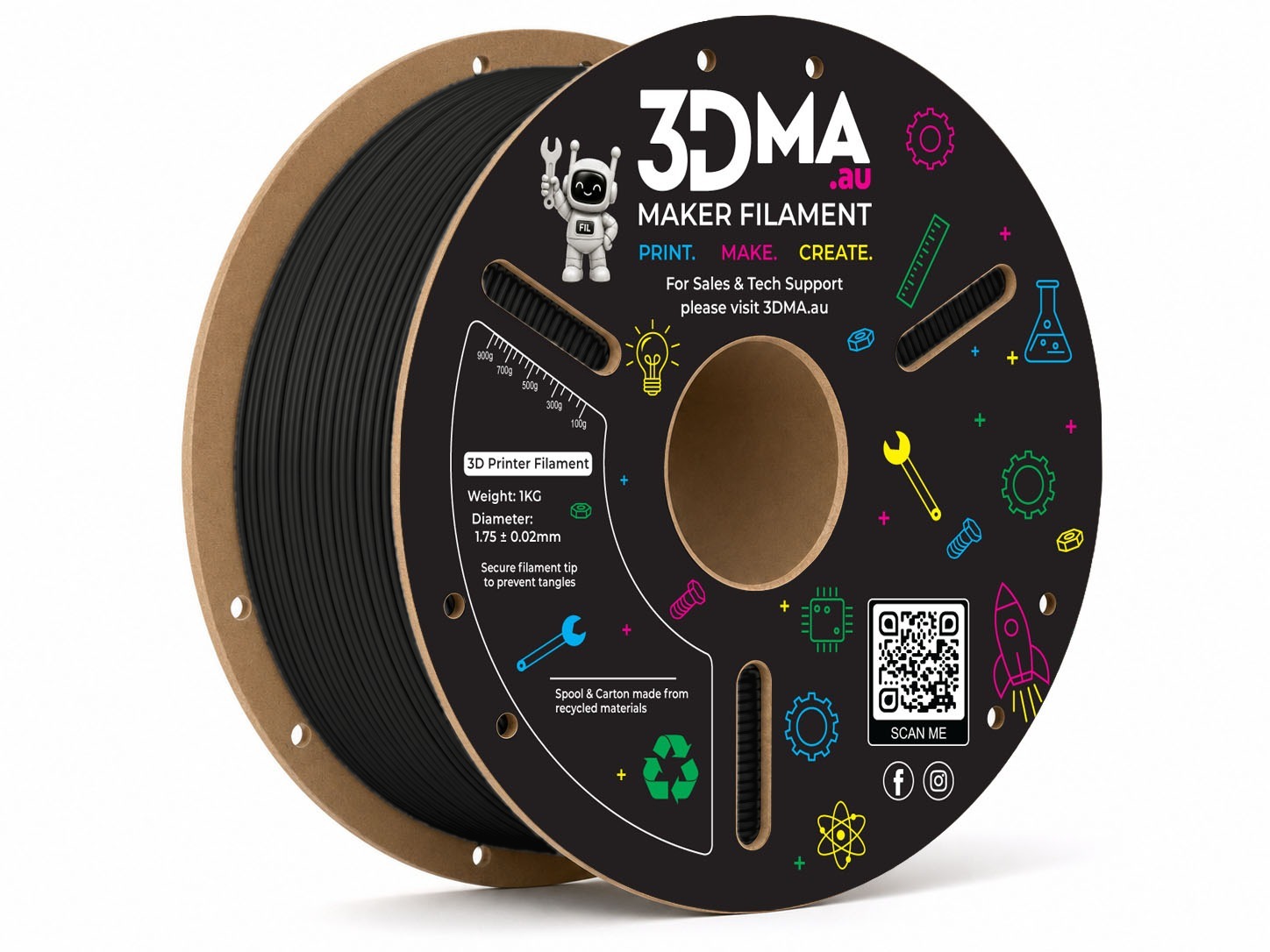
Ultra TPU-95A High Flow is 1.75mm 3D printer filament on a standard 1 kg spool, so it fits any FDM printer that takes 1.75 mm. In practice the question is the extruder rather than the printer: a direct-drive machine handles it straightforwardly, and a Bowden machine needs slowing down. A standard brass nozzle is fine. The spool label states a diameter tolerance of ±0.02 mm, and the filament tip is secured before packing so the spool does not tangle mid-print.
- Bambu Lab
- Prusa
- Creality
- Elegoo
- Anycubic
- Sovol
- Any direct-drive 1.75 mm printer
Storage, drying and shelf life
TPU is one of the thirstiest materials in the range. Wet TPU filament foams and spits at the nozzle, leaves voids through the walls, and produces a part that tears where it should stretch — and because TPU is usually chosen for parts that flex, that is exactly the failure you cannot afford.
Every spool ships sealed with desiccant. Keep it that way between prints and drying will not come up. If a spool has been open on the shelf, the manufacturer’s figure is 70 ± 5 °C in a dryer or blast oven, with storage below 20% relative humidity. The storage and drying guide covers what that looks like in practice.
Technical specifications
Preparation Before Printing
- Drying settings (blast drying oven)
- 70 ± 5 °C
- Printing & storage humidity
- ≤ 20% RH (Sealed with Desiccant)
Recommended Printing Settings
- Nozzle temperature
- 200 - 230 °C
- Bed temperature (with glue)
- 30 - 45 °C
- Printing speed
- < 200 mm/s
Physical Properties
- Density
- 1.27 g/cm³
- Melting temperature
- 190 °C
- Vicat softening temperature
- N/A
- Heat deflection temperature
- N/A
Mechanical Properties
- Tensile strength
- 13 ± 2 MPa
- Elongation at break
- > 500%
Manufacturer figures for Hyper TPU95A, from PETG / TPU / ABS / ASA Parameters. Test values are measured on standard samples and are for design comparison — real-world results depend on your printer, settings and model.
Common questions about Ultra TPU-95A High Flow
Can a regular 3D printer print TPU?
Almost certainly. Any printer with a direct-drive extruder handles TPU with nothing more than slower speeds and reduced retraction, and that covers nearly every machine sold in recent years — Bambu Lab, Prusa, Creality, Elegoo, Anycubic, Sovol. Older Bowden printers can do it too, just more slowly and with shorter retraction distances.
What does 95A mean?
It is the Shore A hardness — the standard scale for rubbery materials. 95A is at the firm end: about as hard as a shopping trolley wheel, and noticeably stiffer than a rubber band. Softer TPUs exist, but they get progressively harder to feed through an extruder, which is why 95A is the practical choice for desktop printing.
Why is TPU hard to print?
Because it is flexible, it buckles instead of pushing when the extruder squeezes it, and long retractions shove it into any gap it can find around the drive gear. Slow the print down, cut retraction distance right back, and use a direct-drive extruder if you have one. Those three changes account for most TPU problems.
Is TPU stronger than PETG?
No, and it is not trying to be. PETG’s tensile strength of 42 MPa is more than three times TPU’s 13 MPa. What TPU has instead is elongation — over 500% against PETG’s 8.9% — which means it stretches and returns rather than resisting and breaking. They are answers to different questions.
Does TPU need an enclosure?
No. It prints at low bed temperatures and barely warps, so an open printer in a normal room is fine.
How much can I print from a 1 kg spool?
At TPU’s density of 1.27 g/cm³, a 1 kg spool of 1.75 mm filament holds roughly 325 metres. Flexible parts are usually printed with low infill and few walls, so a spool tends to last longer than the metres alone suggest.
Can I run TPU through an AMS or multi-material unit?
Check your printer’s documentation before you try. Several multi-material systems route filament through long, tightly curved paths that flexible filament does not survive, and manufacturers publish their own guidance on which flexibles they support. Printing TPU from an external spool holder straight into a direct-drive extruder always works.
Reviews
There are no reviews yet.