
Buy more, save more
- 3–5 rolls 3% off
- 6–9 rolls 6% off
- 10–19 rolls 10% off
- 20+ rolls 15% off
Discount is applied automatically in your cart.
Ultra PETG High Flow
$16.95
1.75 mm diameter · 1 kg net filament per spool
Ultra PETG High Flow is the step up when PLA isn’t tough enough — a durable, slightly flexible workhorse for brackets, fixtures and parts that actually get used, formulated to keep pace with fast printers.
Printing & drying
- Material
- PETG
- Diameter
- 1.75 mm
- Spool
- 1 kg net
- Nozzle
- 240–270°C
- Bed
- 65–75°C
- Printing speed
- < 600 mm/s
- Part cooling
- Low to medium
- Enclosure
- Not required
- Nozzle type
- Standard brass
- Drying
- 60 ± 5°C for 8h
These are typical working ranges for orientation. The label on the spool you receive is authoritative for that batch. More detail in the storage and drying guide and the troubleshooting guide.
Shipping
- Packed and dispatched from Sydney, Australia.
- Every spool ships sealed with desiccant.
- Tracking is provided on every order.
- Buying more than a few spools? Bulk Orders gets you a quote and a supply plan.
Current delivery timeframes are on the Shipping & Returns page.
Returns & warranty
- Backed by the Australian Consumer Law.
- Spool faults are a product fault, not a settings problem. Contact us with your order number and photos.
- Not sure whether it is the spool or the printer? The five-minute triage tells you which half is at fault.
Full terms on the Shipping & Returns page.
Material details
Ultra PETG High Flow is the filament to reach for when PLA is not tough enough and ABS is more trouble than the part is worth. It shrugs off impact, tolerates real heat, resists water and most household chemicals, and it still prints on an open printer with no enclosure — which is why PETG filament is the sensible default for the functional parts most people actually print.
What Ultra PETG High Flow is good for
PETG is polyethylene terephthalate glycol, the same family as a drink bottle, modified so it prints instead of blow-moulding. That chemistry buys two things PLA cannot offer: it bends before it breaks, and it stays rigid at temperatures that would already have PLA sagging. A PETG bracket that gets knocked off a bench flexes and survives. The same part in PLA snaps.
How Ultra PETG High Flow prints
The manufacturer’s published window is a nozzle at 240–270 °C and a bed at 65–75 °C with adhesive, at speeds up to 600 mm/s. That top speed is the point of the High Flow formulation: standard PETG under-extrudes when a fast CoreXY machine asks for more melt than the polymer can supply, and the usual fix is to slow the print down. This one melts readily enough to keep layer bonding intact at speed, so a functional part does not have to be a slow part.
Two habits separate clean PETG from the stringy reputation it carries. Keep part cooling low — somewhere around a third of what you would give PLA — because PETG gets its layer adhesion from staying hot a moment longer. And put a glue-stick layer down first: PETG bonds hard enough to bare PEI or glass that it will take the build surface with it. The troubleshooting guide covers stringing, the other fault people blame on the material.
What Ultra PETG High Flow will not do
Read this before you buy it for the wrong job
PETG has no meaningful UV resistance. A part left in direct Australian sun will chalk, fade and go brittle over a season or two — slower than PLA, but it gets there. For anything that lives in the sun, ASA is the material built for the job.
Its heat deflection temperature is 72 °C and its Vicat softening point is 70 °C. That is comfortably above a hot day and comfortably above PLA, but a car parked in the sun in summer can pass it. PETG also stays glossy and shows layer lines more than matte finishes do, so it is a poor choice for display models.
If any of those apply, the right material is elsewhere in the range:
- ASA — direct sun & UV
- ABS — more heat
- PETG-CF — stiffer
- Matte PETG — same strength, no shine
- PLA — indoors & easy
The Materials Guide sets PLA, PETG, ABS, ASA and TPU against each other with the numbers side by side, if you would rather compare than guess.
Every colour, one material
Every colour of this PETG filament is the same polymer with the same settings — only the pigment changes. A colour you tuned last year behaves the same way this year, and a multi-colour print does not need per-colour profiles. Each colour is its own tile in the store, so what you click is what arrives.
Printer compatibility
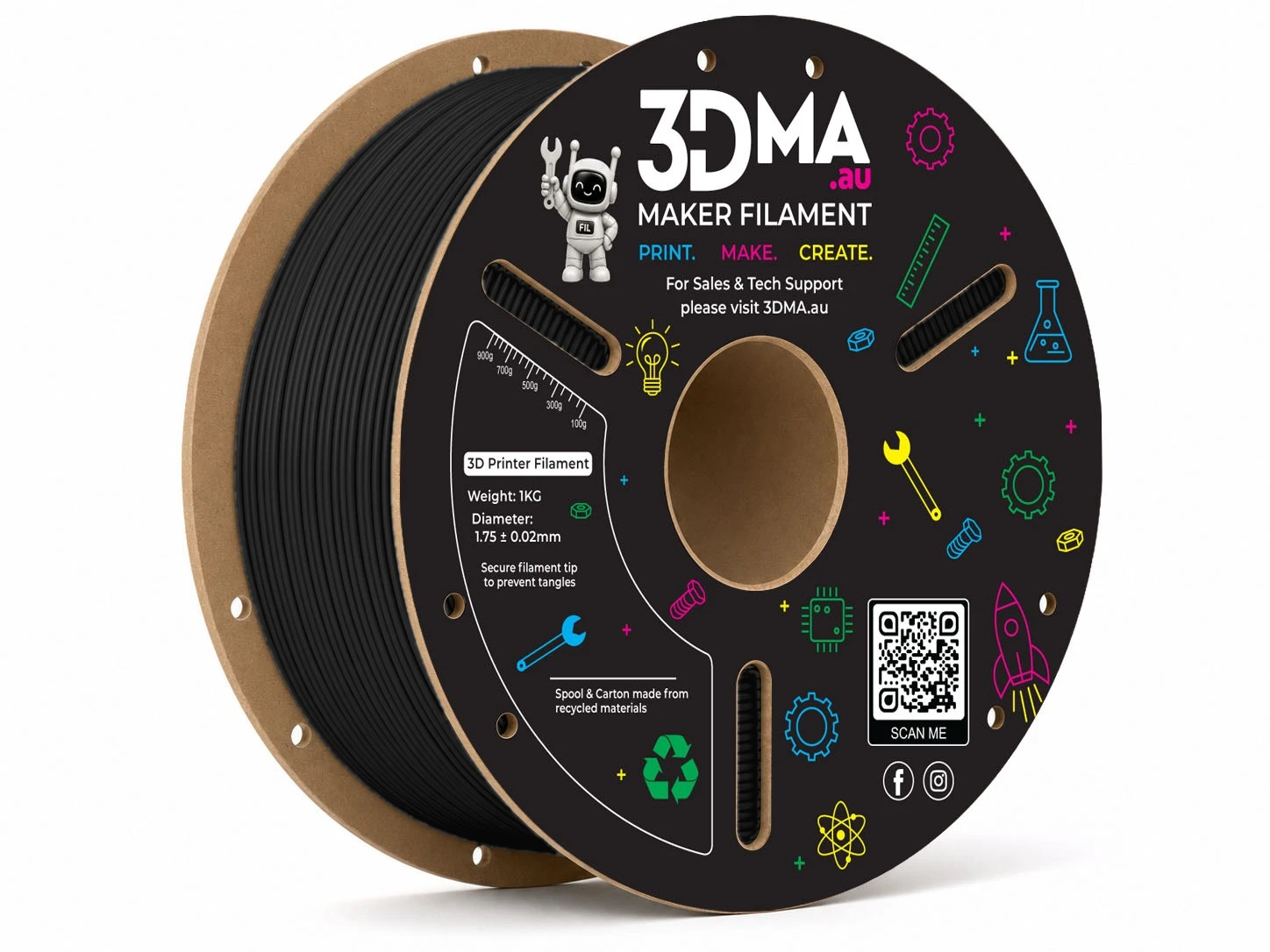
Ultra PETG High Flow is 1.75mm 3D printer filament on a standard 1 kg spool, so it runs on any FDM printer that takes 1.75 mm — Bambu Lab, Prusa, Creality, Elegoo, Anycubic and the rest. No hardened nozzle is needed, because unfilled PETG carries nothing abrasive. The spool label states a diameter tolerance of ±0.02 mm, and the filament tip is secured before packing so the spool does not tangle mid-print.
- Bambu Lab
- Prusa
- Creality
- Elegoo
- Anycubic
- Sovol
- Any 1.75 mm FDM printer
Storage, drying and shelf life
PETG is more hygroscopic than PLA — it pulls moisture out of the air faster, and it shows. Wet PETG filament hisses and pops at the nozzle, strings between every feature, and prints with a cloudy, bubbled surface that no amount of retraction tuning will fix. On a humid east-coast summer a spool left open on the shelf can get there in days rather than months.
Every spool ships sealed with desiccant. Keep it that way between prints and drying is not something you will have to think about. If a spool has been open through a wet season, the manufacturer’s figure is 60 ± 5 °C for 8 hours in a dryer or blast oven, with storage below 20% relative humidity. The storage and drying guide covers what that looks like in practice.
Technical specifications
Preparation Before Printing
- Drying settings (blast drying oven)
- 60 ± 5 °C for 8h
- Printing & storage humidity
- ≤ 20% RH (Sealed with Desiccant)
Recommended Printing Settings
- Nozzle temperature
- 240 - 270 °C
- Bed temperature (with glue)
- 65 - 75 °C
- Printing speed
- < 600 mm/s
Physical Properties
- Density
- 1.29 g/cm³
- Melt index
- 13.4 ± 3.8 g/10 min
- Melting temperature
- 216 °C
- Vicat softening temperature
- 70 °C
- Heat deflection temperature
- 72 °C
Mechanical Properties
- Tensile strength
- 42 ± 2 MPa
- Elongation at break
- 8.9% ± 1.5%
- Bending strength
- 68 ± 2 MPa
- Bending modulus
- 2097 ± 173 MPa
- Impact strength
- 67.6 ± 4.2 kJ/m²
Manufacturer figures for Hyper PETG, from PETG / TPU / ABS / ASA Parameters. Test values are measured on standard samples and are for design comparison — real-world results depend on your printer, settings and model.
Common questions about Ultra PETG High Flow
Is PETG stronger than PLA?
It depends which kind of strength you mean. PLA is stiffer and slightly higher in tensile strength. PETG is far tougher: its impact strength of 67.6 ± 4.2 kJ/m² is what lets a part survive being dropped, and it bends before it breaks where PLA snaps. For anything that gets handled, loaded or knocked, PETG is the stronger choice in the way that matters.
Why does PETG have a reputation for being difficult to print?
Three things, all fixable. It strings if the nozzle is too hot or retraction is untuned. It bonds so well to bare PEI and glass that it can pull chunks out of the build surface — use a glue stick as a release layer. And it wants far less part cooling than PLA, so a profile copied across from PLA will give weak, delaminated layers. Get those three right and it prints as reliably as anything in the range.
Do I need an enclosure for PETG?
No. PETG barely warps and does not need a heated chamber, which is most of why it is the practical step up from PLA rather than ABS. An enclosure does not hurt, but nothing about this material requires one.
Can PETG parts live outside?
In the shade, yes — under an eave, in a shed, on a shaded balcony. In direct sun, no. PETG has no useful UV resistance and will chalk and embrittle over a season or two of Australian summer. That is precisely the job Core ASA exists for.
Will PETG work with my printer?
If your printer takes 1.75 mm filament and its hotend reaches 250 °C, yes. That covers Bambu Lab, Prusa, Creality, Elegoo, Anycubic, Sovol and effectively every current desktop FDM machine. Standard brass nozzle, no hardware change. It also runs in an AMS or other multi-material unit, provided the spool is dry.
How much can I print from a 1 kg spool?
At PETG’s density of 1.29 g/cm³, a 1 kg spool of 1.75 mm filament holds roughly 320 metres. What that turns into depends entirely on your models — a wall bracket at a sensible infill typically lands in the tens of grams, so a spool goes a long way.
Should I choose PETG or ABS?
PETG unless you specifically need the heat. ABS holds its shape to a higher temperature and can be acetone-smoothed, but it wants an enclosure and ventilation and it warps if you look at it wrong. PETG gives you most of the toughness on an open printer with none of the fumes. The Materials Guide lays out where the line sits.
Reviews
There are no reviews yet.