
Buy more, save more
- 3–5 rolls 3% off
- 6–9 rolls 6% off
- 10–19 rolls 10% off
- 20+ rolls 15% off
Discount is applied automatically in your cart.
Ultra ABS High Flow
$16.95
1.75 mm diameter · 1 kg net filament per spool
Ultra ABS High Flow is the classic engineering plastic — the material of LEGO bricks and car interiors — for makers with an enclosed printer who need parts that take heat, impact and post-processing.
Printing & drying
- Material
- ABS
- Diameter
- 1.75 mm
- Spool
- 1 kg net
- Nozzle
- 230–270°C
- Bed
- 75–95°C
- Printing speed
- < 300 mm/s
- Part cooling
- Off or minimal
- Enclosure
- Required, with ventilation
- Nozzle type
- Standard brass
- Drying
- 70 ± 5°C for 8h
These are typical working ranges for orientation. The label on the spool you receive is authoritative for that batch. More detail in the storage and drying guide and the troubleshooting guide.
Shipping
- Packed and dispatched from Sydney, Australia.
- Every spool ships sealed with desiccant.
- Tracking is provided on every order.
- Buying more than a few spools? Bulk Orders gets you a quote and a supply plan.
Current delivery timeframes are on the Shipping & Returns page.
Returns & warranty
- Backed by the Australian Consumer Law.
- Spool faults are a product fault, not a settings problem. Contact us with your order number and photos.
- Not sure whether it is the spool or the printer? The five-minute triage tells you which half is at fault.
Full terms on the Shipping & Returns page.
Material details
Ultra ABS High Flow is the classic engineering plastic — the material Lego bricks and car interiors are made from — formulated to keep pace with modern printers. Its reason to exist is heat: it holds its shape to a heat deflection temperature of 85 °C, nearly 30 °C beyond PLA, which puts it in a different class for anything that lives somewhere warm.
What Ultra ABS High Flow is good for
ABS is acrylonitrile butadiene styrene: rigid, machinable, and the only material in the range you can smooth with acetone vapour into a glossy, seamless finish. It is a demanding print — it needs an enclosure and it warps if the chamber cools — but nothing else in the range does what it does for the price.
How Ultra ABS High Flow prints
The manufacturer’s published window is a nozzle at 230–270 °C and a bed at 75–95 °C with adhesive, at speeds up to 300 mm/s. Everything else about printing ABS well comes down to one idea: keep the part warm. Part cooling should be off or close to it, and the printer needs an enclosure so the chamber holds its heat — a draught across a tall ABS print is what splits it along a layer line halfway up.
A brim or a raft on the first layer is worth the plastic on anything with a large footprint, and adhesive on the bed is not optional. The High Flow formulation melts more readily than traditional ABS, so a fast machine can actually use its speed rather than under-extruding its way to a weak part.
What Ultra ABS High Flow will not do
Read this before you buy it for the wrong job
ABS produces a styrene smell while printing and needs ventilation. It is not the material for a bedroom, a closed office or a classroom — for a room full of students, PLA is the responsible answer, and our guide for Australian schools sets out the ventilation rules per material.
It also is not the toughest thing in the range, despite the reputation. Its impact strength of 14.9 ± 3.2 kJ/m² is well below PETG’s, and at 7.2% elongation at break it is not far off PLA for brittleness. Buy ABS for heat resistance and finishing, not for surviving a drop. And it has no useful UV resistance: outdoors in the sun it yellows and embrittles, which is the entire reason ASA exists.
If any of those apply, the material you want is elsewhere in the range:
- ASA — ABS that survives the sun
- PETG — tougher, no enclosure
- ABS-CF — stiffer & more stable
- PLA — indoors & easy
The Materials Guide compares all of them side by side with the published numbers.
Every colour, one material
Every colour of this ABS filament is the same polymer with the same settings — only the pigment changes. A profile you tuned for one colour carries straight across to the next, and a colour you liked last year behaves the same way this year. Each colour is its own tile in the store, so what you click is what arrives.
Printer compatibility
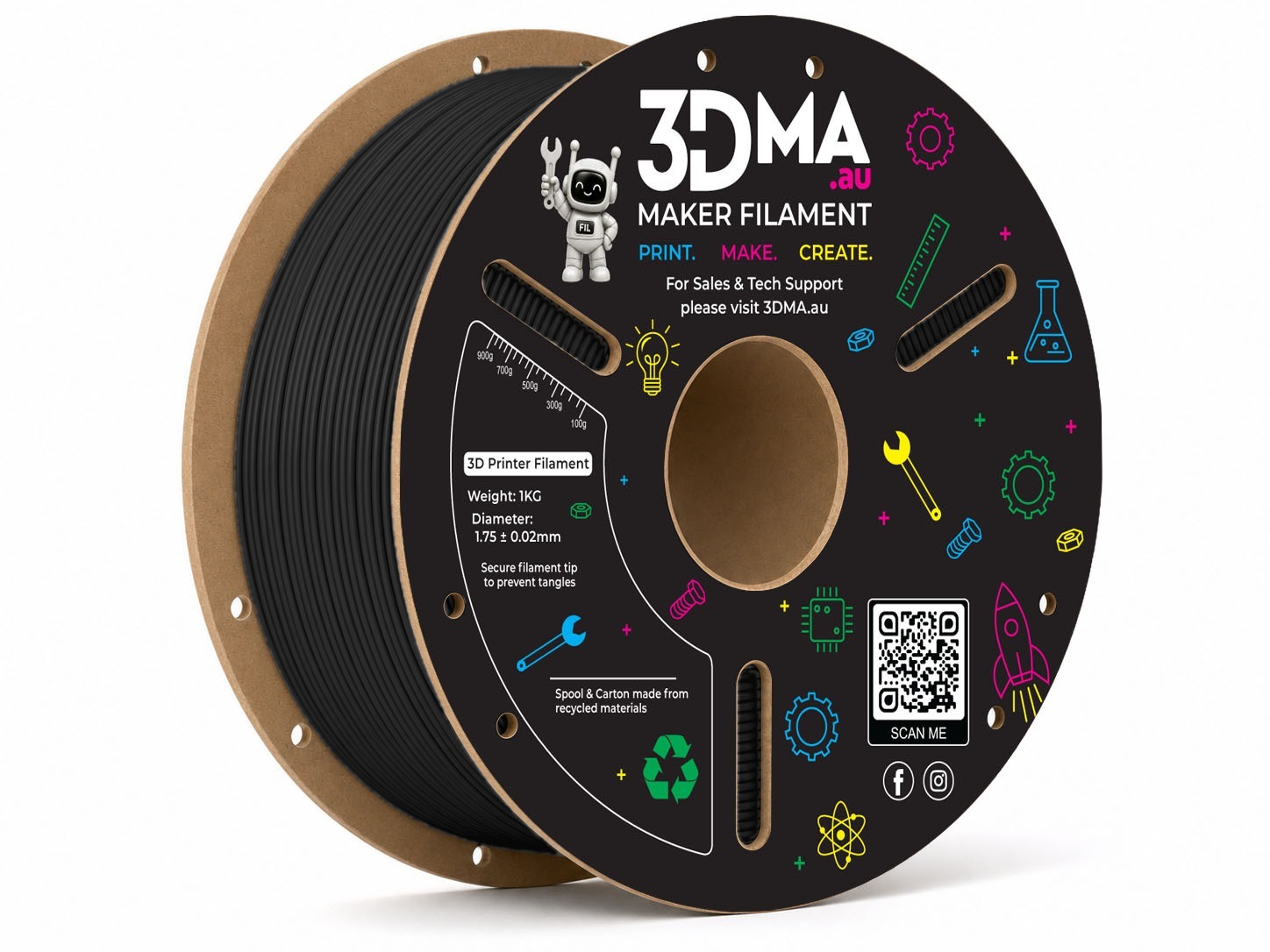
Ultra ABS High Flow is 1.75mm 3D printer filament on a standard 1 kg spool, so it fits any FDM printer that takes 1.75 mm — but unlike PLA or PETG, the printer also has to suit the material. You want an enclosure, a bed that reaches 95 °C, and a hotend rated to 270 °C. A standard brass nozzle is fine; unfilled ABS carries nothing abrasive. The spool label states a diameter tolerance of ±0.02 mm, and the filament tip is secured before packing so the spool does not tangle mid-print.
- Bambu Lab X1 & P1 series
- Prusa MK4 with enclosure
- Creality K-series
- Qidi
- Any enclosed 1.75 mm FDM printer
Storage, drying and shelf life
ABS absorbs less moisture than PETG or nylon, but a wet spool still shows itself: bubbling at the nozzle, a rough surface, and layer bonding that gives up under load. Given that ABS prints are usually the ones being asked to do a job, that is the worst place to lose strength.
Every spool ships sealed with desiccant. Keep it that way between prints and drying will not come up. If a spool has been open through a humid season, the manufacturer’s figure is 70 ± 5 °C for 8 hours in a dryer or blast oven, with storage below 20% relative humidity — note the higher temperature than PLA or PETG, which many cheaper dryers cannot reach. The storage and drying guide covers which ones can.
Technical specifications
Preparation Before Printing
- Drying settings (blast drying oven)
- 70 ± 5 °C for 8h
- Printing & storage humidity
- ≤ 20% RH (Sealed with Desiccant)
Recommended Printing Settings
- Nozzle temperature
- 230 - 270 °C
- Bed temperature (with glue)
- 75 - 95 °C
- Printing speed
- < 300 mm/s
Physical Properties
- Density
- 1.06 g/cm³
- Melt index
- 8.8 ± 0.3 g/10 min
- Melting temperature
- 216 °C
- Vicat softening temperature
- 86 °C
- Heat deflection temperature
- 85 °C
Mechanical Properties
- Tensile strength
- 38 ± 1.5 MPa
- Elongation at break
- 7.2% ± 0.2%
- Bending strength
- 68 ± 2 MPa
- Bending modulus
- 2284 ± 115 MPa
- Impact strength
- 14.9 ± 3.2 kJ/m²
Manufacturer figures for Hyper ABS, from PETG / TPU / ABS / ASA Parameters. Test values are measured on standard samples and are for design comparison — real-world results depend on your printer, settings and model.
Common questions about Ultra ABS High Flow
Do I need an enclosed printer to print ABS?
In practice, yes. ABS shrinks as it cools, and if the chamber is cooler than the part the layers pull against each other until something lets go — corners lift off the bed, or a tall print splits along a layer line. An enclosure keeps the chamber warm enough that the shrinkage happens evenly. You can sometimes get a small ABS part off an open printer in a warm room with no draught, but it is not a way to work.
Is ABS stronger than PETG?
Not in impact. PETG’s impact strength of 67.6 kJ/m² is more than four times this ABS’s 14.9 kJ/m², so a dropped PETG part survives where an ABS one cracks. ABS wins decisively on heat — 85 °C heat deflection against PETG’s 72 — and on how well it finishes by hand. Choose on which of those the part actually needs.
Is ABS better than PLA?
Only for specific jobs. ABS holds its shape far hotter, sands and glues better, and can be vapour-smoothed. PLA prints more easily, more accurately, with a better surface, no smell and no enclosure. If the part lives indoors and does not get warm, PLA is the better answer and it is not close.
Can ABS parts be used outdoors in Australia?
Only in the shade. ABS handles the heat fine but has no meaningful UV resistance — in direct sun it yellows, chalks and goes brittle. Core ASA is chemically ABS with the UV problem solved, and it prints almost identically.
Is ABS safe to print at home?
With ventilation, yes. ABS gives off a noticeable styrene smell and ultrafine particles while printing, so it belongs in a ventilated room, a garage or a shed rather than a bedroom or a closed office. An enclosure with filtered extraction handles it well. PLA and PETG do not carry the same requirement.
How much can I print from a 1 kg spool?
ABS is the lightest material in the range at 1.06 g/cm³, so a 1 kg spool of 1.75 mm filament holds roughly 390 metres — about 60 metres more than the same weight of PLA. The same part printed in ABS also weighs less than it would in PLA or PETG.
Can I really smooth ABS with acetone?
Yes, and it is the main reason people still choose it over PETG. Suspending the part above acetone vapour softens the outer surface just enough to flow the layer lines together, leaving a glossy, injection-moulded look no amount of slicer tuning will match. Do it outdoors or in a well-ventilated space, and expect fine detail to soften along with everything else.
Reviews
There are no reviews yet.