
Buy more, save more
- 3–5 rolls 3% off
- 6–9 rolls 6% off
- 10–19 rolls 10% off
- 20+ rolls 15% off
Discount is applied automatically in your cart.
Rainbow-Silk PLA
$24.95
1.75 mm diameter · 1 kg net filament per spool
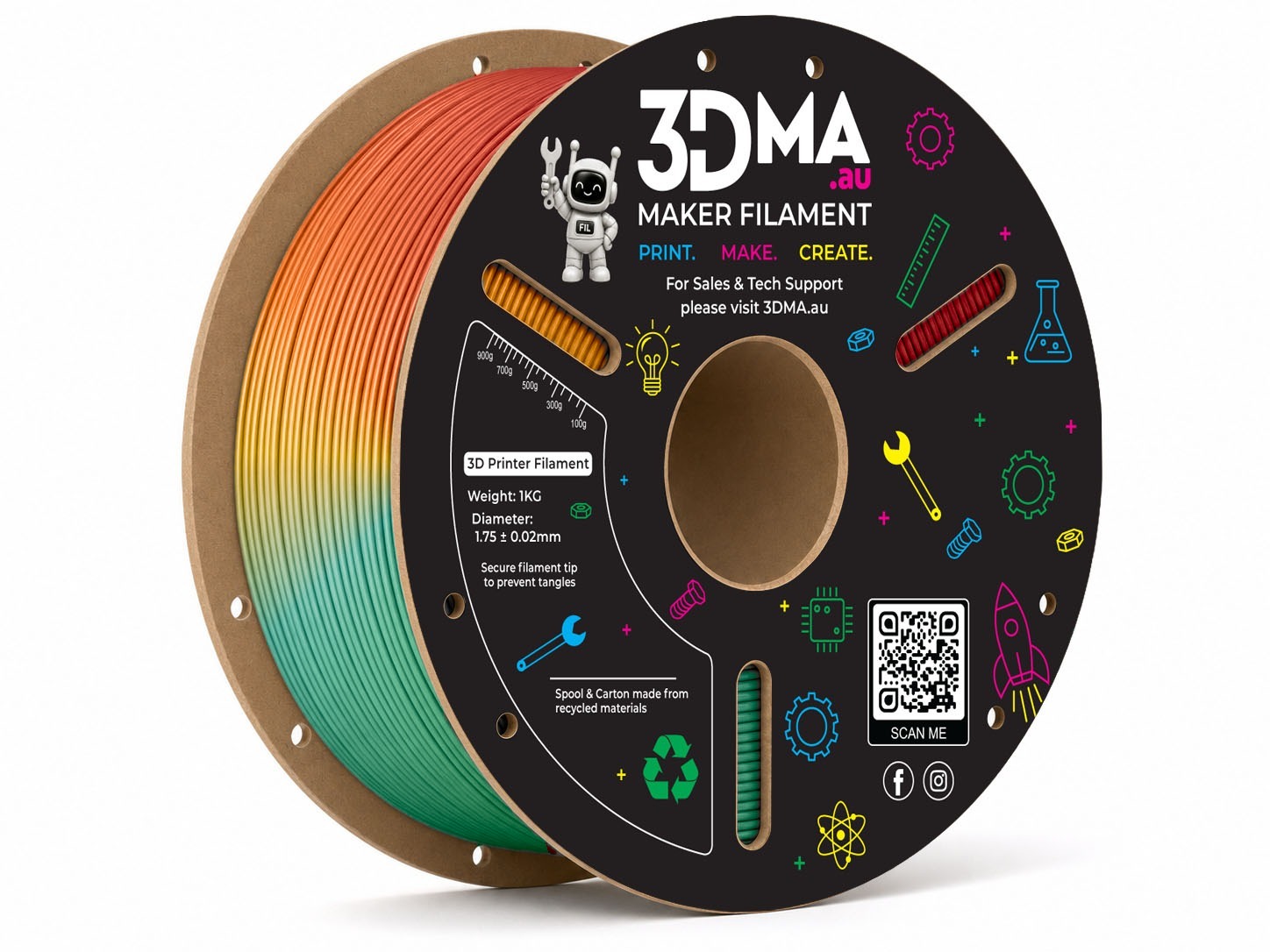
Rainbow-Silk PLA changes colour gradually along the spool, so tall prints climb through a glossy spectrum — reds into golds into greens into blues — without a single filament swap.
Printing & drying
- Material
- PLA
- Diameter
- 1.75 mm
- Spool
- 1 kg net
- Nozzle
- 190–230°C
- Bed
- 35–65°C
- Printing speed
- < 220 mm/s
- Part cooling
- High
- Enclosure
- Not required
- Nozzle type
- Standard brass
- Drying
- 50 ± 5°C for 8h
These are typical working ranges for orientation. The label on the spool you receive is authoritative for that batch. More detail in the storage and drying guide and the troubleshooting guide.
Shipping
- Packed and dispatched from Sydney, Australia.
- Every spool ships sealed with desiccant.
- Tracking is provided on every order.
- Buying more than a few spools? Bulk Orders gets you a quote and a supply plan.
Current delivery timeframes are on the Shipping & Returns page.
Returns & warranty
- Backed by the Australian Consumer Law.
- Spool faults are a product fault, not a settings problem. Contact us with your order number and photos.
- Not sure whether it is the spool or the printer? The five-minute triage tells you which half is at fault.
Full terms on the Shipping & Returns page.
Material details
Rainbow-Silk PLA changes colour along its length rather than across the strand. As the printer consumes filament the active colour shifts gradually, painting horizontal bands of changing colour up the print — so the taller the model, the more of the rainbow it captures. Every print lands on a different stretch of spool, which means no two are ever quite the same.
What Rainbow-Silk PLA is good for
This one is about vertical real estate. The transitions happen over several metres of filament, so a short print may sit entirely within one colour while a tall vase walks through the whole sequence. Choose models with height and the material does the rest.
How Rainbow-Silk PLA prints
The manufacturer’s published window is a nozzle at 190–230 °C and a bed at 35–65 °C with adhesive, at speeds up to 220 mm/s — the silk PLA envelope. Handle it as silk first: warm nozzle, reduced part cooling, slow outer wall. The sheen is what makes each colour band blend into the next rather than stack.
One planning note that is unique to this material: how much colour a print captures depends on how much filament it uses, not how tall it is on screen. A thin-walled vase uses far less material per millimetre of height than a solid model, so it climbs through the sequence more slowly. Vase mode gives the smoothest gradient of all.
What Rainbow-Silk PLA will not do
Read this before you buy it for the wrong job
Small prints may show no transition at all. The colour changes over several metres of filament, so a keyring or a 40 mm figurine can sit entirely inside one section and come out a single colour. If you want colour variation on a small print, Dual-Silk is the material that does it.
It also shares silk PLA’s mechanical numbers — a tensile strength of 26 ± 3 MPa and an impact strength of 25.5 ± 2.2 kJ/m², the lowest in the catalogue, with decorative-grade layer adhesion and 54 °C heat deflection. Nothing structural, nothing outdoors.
If you need the effect at a smaller scale or in something tougher, the range goes elsewhere:
- Dual-Silk — two colours, any size
- Tri-Silk — three colours, large prints
- Silk PLA — single colour, same gloss
- Core PLA — tough and plain
The Materials Guide sets the decorative PLAs side by side with the published numbers.
Every sequence, one material
Both Rainbow-Silk sequences are the same polymer with the same settings — only the colour run changes. A profile tuned for one carries straight across to the other. Each sequence is its own tile in the store, so what you click is what arrives.
2 colours in this material
Printer compatibility
Rainbow-Silk PLA is 1.75mm 3D printer filament on a standard 1 kg spool, so it runs on any FDM printer that takes 1.75 mm — Bambu Lab, Prusa, Creality, Elegoo, Anycubic and the rest. Standard brass nozzle, no hardware change, and no multi-material unit required: the colour change is in the filament. The spool label states a diameter tolerance of ±0.02 mm, and the filament tip is secured before packing so the spool does not tangle mid-print.
- Bambu Lab
- Prusa
- Creality
- Elegoo
- Anycubic
- Sovol
- Any 1.75 mm FDM printer
Storage, drying and shelf life
Moisture flattens the sheen, and without the sheen the colour bands stop blending into one another and start looking like stripes. A damp spool prints dull and patchy rather than obviously faulty, which makes the cause easy to miss.
Every spool ships sealed with desiccant. Keep it that way between prints and drying will not come up. If a spool has been open through a humid season, the manufacturer’s figure is 50 ± 5 °C for 8 hours in a dryer or blast oven, with storage below 20% relative humidity. The storage and drying guide covers what that looks like in practice.
Technical specifications
Preparation Before Printing
- Drying settings (blast drying oven)
- 50 ± 5 °C for 8h
- Printing & storage humidity
- ≤ 20% RH (Sealed with Desiccant)
Recommended Printing Settings
- Nozzle temperature
- 190 - 230 °C
- Bed temperature (with glue)
- 35 - 65 °C
- Printing speed
- < 220 mm/s
Physical Properties
- Density
- 1.25 g/cm³
- Melt index
- 28.7 ± 2.1 g/10 min
- Melting temperature
- 164 °C
- Vicat softening temperature
- 58 °C
- Heat deflection temperature
- 54 °C
Mechanical Properties
- Tensile strength
- 26 ± 3 MPa
- Elongation at break
- 9.7% ± 2.3%
- Bending strength
- 79 ± 2 MPa
- Bending modulus
- 2816 ± 136 MPa
- Impact strength
- 25.5 ± 2.2 kJ/m²
Manufacturer figures for PLA Silk, from PLA Series Parameters. Test values are measured on standard samples and are for design comparison — real-world results depend on your printer, settings and model.
Common questions about Rainbow-Silk PLA
How long is one colour transition?
Several metres of filament, which is why tall prints show the effect best and small ones may not show it at all. What matters is how much filament the print consumes, not how tall the model looks on screen.
Why did my print come out one colour?
It used too little filament to reach the next transition. That is normal on small prints. Print taller, print more of them in one job so the spool advances, or switch to Dual-Silk, which changes colour across the strand rather than along it.
Can I predict which colours I will get?
Not precisely. Each print starts wherever the previous one finished on the spool, so the sequence is different every time. For most people that is the appeal — a set of vases from one spool will never be a matching set.
Do I need a multi-material printer?
No. The colour change is manufactured into the filament. One nozzle, one spool, no AMS, no purge waste.
Is it as strong as normal PLA?
No. It shares silk PLA’s figures — 26 MPa tensile and 25.5 kJ/m² impact strength, the lowest in the catalogue. It is a display material. Print anything functional in Core PLA or PLA+.
What gives the smoothest gradient?
Vase mode. A single continuous wall with no seams, no infill and no travel moves lets the colour shift evenly all the way up, with nothing to interrupt it. It is also the print type this material was made for.
How much can I print from a 1 kg spool?
At a density of 1.25 g/cm³, a 1 kg spool of 1.75 mm filament holds roughly 335 metres. Because thin-walled prints advance slowly through the colour sequence, a single spool can produce a lot of vases and still have colours you have not seen yet.
Reviews
There are no reviews yet.