
Buy more, save more
- 3–5 rolls 3% off
- 6–9 rolls 6% off
- 10–19 rolls 10% off
- 20+ rolls 15% off
Discount is applied automatically in your cart.
PLA-CF
$24.95
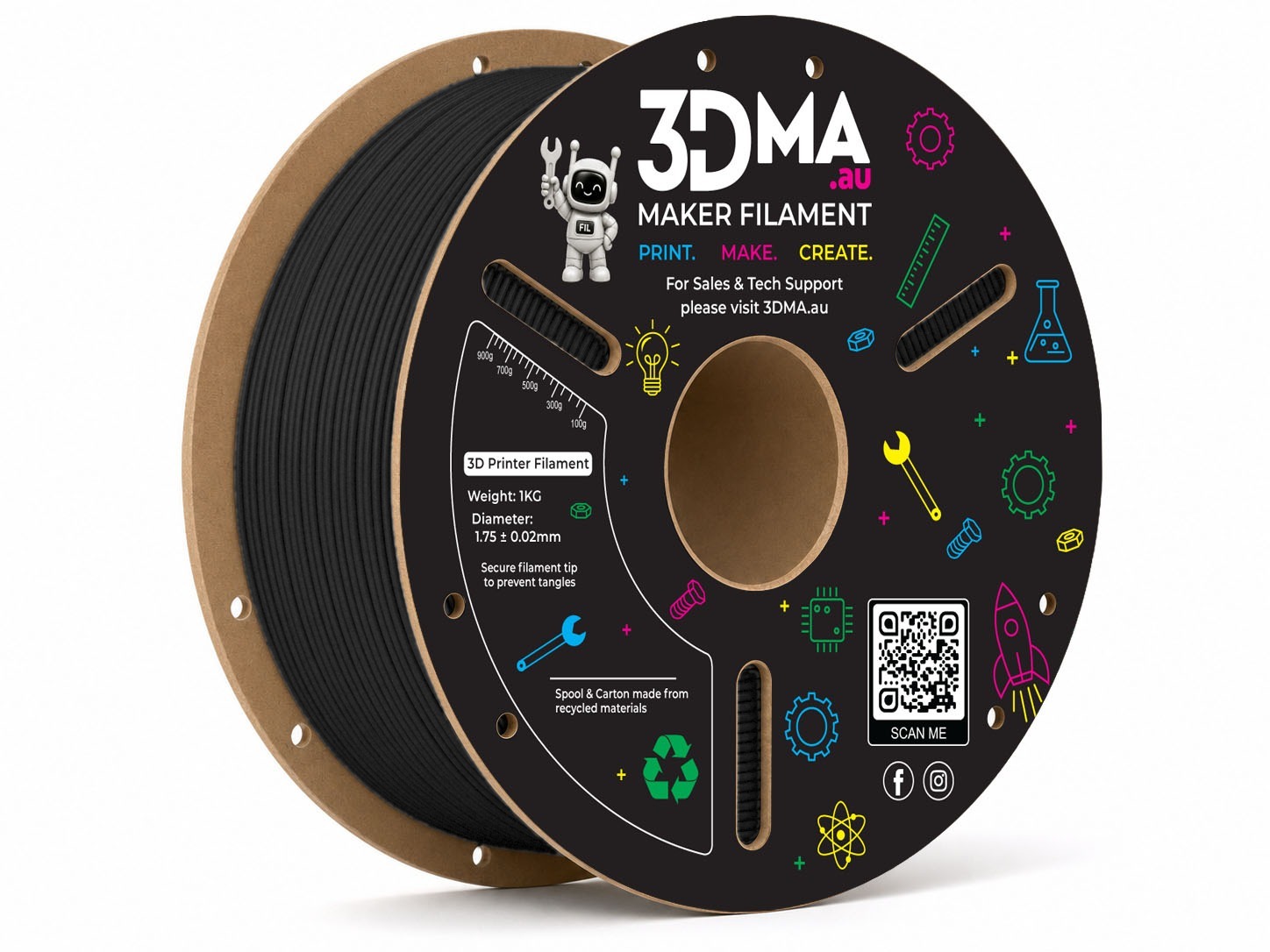
1.75 mm diameter · 1 kg net filament per spool
PLA-CF blends carbon fibre into PLA for parts that are stiffer, more dimensionally stable and dressed in a matte technical finish — the gentlest introduction to composite printing.
Printing & drying
- Material
- PLA composite
- Diameter
- 1.75 mm
- Spool
- 1 kg net
- Nozzle
- 210–240°C
- Bed
- 35–65°C
- Printing speed
- < 300 mm/s
- Part cooling
- High
- Enclosure
- Not required
- Nozzle type
- Hardened steel, 0.6 mm or larger
- Drying
- 50 ± 5°C for 8h
These are typical working ranges for orientation. The label on the spool you receive is authoritative for that batch. More detail in the storage and drying guide and the troubleshooting guide.
Shipping
- Packed and dispatched from Sydney, Australia.
- Every spool ships sealed with desiccant.
- Tracking is provided on every order.
- Buying more than a few spools? Bulk Orders gets you a quote and a supply plan.
Current delivery timeframes are on the Shipping & Returns page.
Returns & warranty
- Backed by the Australian Consumer Law.
- Spool faults are a product fault, not a settings problem. Contact us with your order number and photos.
- Not sure whether it is the spool or the printer? The five-minute triage tells you which half is at fault.
Full terms on the Shipping & Returns page.
Material details
PLA-CF is carbon fibre chopped into PLA, and what it buys is stiffness. A bending modulus of 3341 ± 172 MPa makes it the most rigid material in the PLA range, it barely warps, and it prints with a deep matte-black finish that hides layer lines completely. What it does not buy is toughness — stiffer is not the same as stronger, and that distinction decides whether this is the right filament for your part.
What PLA-CF is good for
Adding short carbon fibres to a polymer does three things at once: it raises stiffness, it cuts shrinkage so parts hold their dimensions, and it turns a glossy surface into a fine matte texture. PLA-CF gets all three while still printing at PLA temperatures on an open printer, which is why it is the easiest composite in the range to live with.
How PLA-CF prints
The manufacturer’s published window is a nozzle at 210–240 °C and a bed at 35–65 °C with adhesive, at speeds up to 300 mm/s — a touch hotter than unfilled PLA, because the fibres raise the viscosity of the melt. Everything else ab ut it prints like PLA: no enclosure, high part cooling, no special build surface.
The nozzle is the one thing you cannot skip. Carbon fibre is abrasive, and a brass nozzle printing filled filament wearso ut of round in a matter of spools — you will see it as inconsistent extrusion long before you worko ut why. A hardened steel nozzle at 0.6 mm or wider costs a fraction of the filament and also reduces the risk of a fibre bundle bridging the orifice.
What PLA-CF will not do
Read this before you buy it for the wrong job
Stiffer is not tougher. PLA-CF’s impact strength of 24.7 ± 1.5 kJ/m² is well under a third of unfilled Core PLA’s 66.2, and at 7.5% elongation at break it snaps with almost no warning. Carbon fibre resists bending — and then fails suddenly when it finally does bend. For anything that gets dropped or shock-loaded, this is the wrong material.
It is also still PLA underneath. Its heat deflection temperature of 56 °C is no better than Core PLA’s, so a PLA-CF part on a dashboard sags exactly like a plain one. And it has no UV resistance. Carbon fibre changes how a part behaves under load, not where it can live.
If you need the stiffness with heat or toughness alongside it, the composite range goes further:
- PETG-CF — stiff and tough
- ABS-CF — stiff at 90 °C
- PETG-GF — glass instead of carbon
- Core PLA — tougher, cheaper, easier
The Materials Guide has a section on composites specifically, including why a hardened nozzle stops being optional.
Finish and colour
PLA-CF comes in one finish, and it is the point of the material: a deep matte black with a fine granular texture from the fibre itself. Layer lines effectively disappear, so a part looks finished straight off the plate. It does not take paint as readily as smooth PLA — the texture is part of the appeal rather than a base coat.
1 colours in this material
Printer compatibility
PLA-CF is 1.75mm 3D printer filament on a standard 1 kg spool, so it fits any FDM printer that takes 1.75 mm — Bambu Lab, Prusa, Creality, Elegoo, Anycubic and the rest — with one hardware requirement: a hardened steel nozzle, 0.6 mm or larger. Many current machines ship with one already; older printers usually need a five-minute swap. The spool label states a diameter tolerance of ±0.02 mm, and the filament tip is secured before packing so the spool does not tangle mid-print.
- Bambu Lab
- Prusa
- Creality
- Elegoo
- Anycubic
- Sovol
- Hardened steel nozzle required
Storage, drying and shelf life
Filled filaments hold moisture around the fibre as well as in the polymer, so PLA-CF is worth keeping sealed even more than plain PLA. Wet PLA-CF prints with a furry surface and an inconsistent extrusion that is easy to mistake for a worn nozzle.
Every spool ships sealed with desiccant. Keep it that way between prints and drying will not come up. If a spool has been open through a humid season, the manufacturer’s figure is 50 ± 5 °C for 8 hours in a dryer or blast oven, with storage below 20% relative humidity. The storage and drying guide covers what that looks like in practice.
Technical specifications
Preparation Before Printing
- Drying settings (blast drying oven)
- 50 ± 5 °C for 8h
- Printing & storage humidity
- ≤ 20% RH (Sealed with Desiccant)
Recommended Printing Settings
- Nozzle temperature
- 210 - 240 °C
- Bed temperature (with glue)
- 35 - 65 °C
- Printing speed
- < 300 mm/s
Physical Properties
- Density
- 1.24 g/cm³
- Melt index
- 9.7 ± 1.2 g/10 min
- Melting temperature
- 165 °C
- Vicat softening temperature
- 64 °C
- Heat deflection temperature
- 56 °C
Mechanical Properties
- Tensile strength
- 39 ± 3 MPa
- Elongation at break
- 7.5% ± 1.3%
- Bending strength
- 78 ± 2 MPa
- Bending modulus
- 3341 ± 172 MPa
- Impact strength
- 24.7 ± 1.5 kJ/m²
Manufacturer figures for PLA-CF, from PLA Series Parameters. Test values are measured on standard samples and are for design comparison — real-world results depend on your printer, settings and model.
Common questions ab ut PLA-CF
Is carbon fibre filament actually stronger?
Stiffer, yes. Stronger, it depends what breaks it. PLA-CF’s bending modulus of 3341 MPa is the highest in the PLA range, so it resists deflection better than anything else here. But its impact strength of 24.7 kJ/m² is far below plain PLA’s 66.2, so it cracks where a plain PLA part would survive. Choose it when the part must not flex, not when it must not break.
Do I need a hardened nozzle for PLA-CF?
Yes, and it is not a suggestion. Chopped carbon fibre wearsobrass away from the inside, and a worn nozzle extrudes inconsistently and driftso ut of calibration with ut any obvious cause. A hardened steel nozzle at 0.6 mm or larger is the standard fitting for every filled filament in this range.
Can any 3D printer use carbon fibre filament?
Almost any, once it has a hardened nozzle. PLA-CF prints at PLA temperatures with no enclosure, so there is no other hardware requirement. The wider 0.6 mm nozzle also reduces the chance of a fibre bundle blocking the orifice mid-print.
Is PLA-CF more heat resistant than PLA?
No. Its heat deflection temperature of 56 °C is effectively the same as Core PLA’s 57. Carbon fibre raises stiffness, not the temperature at which the polymer around it softens. For heat, you want ABS-CF at 90 °C or Core ASA at 99.
Why does PLA-CF warp less than plain PLA?
The fibres physically restrain the polymer as it shrinks on cooling, so the part contracts less and pulls less against the bed. It is the same reason filled filaments hold dimensional tolerance better, and it is most noticeable on large flat parts where plain PLA liftsoat the corners.
How much can I print from a 1 kg spool?
At PLA-CF’s density of 1.24 g/cm³, a 1 kg spool of 1.75 mm filament holds roughly 335 metres — very close to plain PLA, since the fibre loading barely shifts the density.
Does the surface need sanding or painting?
It does not need either, and it does not take either especially well. The matte texture that comes off the plate is the finish the material isobought for. If you want a paintable surface, print in smooth PLA and paint that instead.
Reviews
There are no reviews yet.