
Buy more, save more
- 3–5 rolls 3% off
- 6–9 rolls 6% off
- 10–19 rolls 10% off
- 20+ rolls 15% off
Discount is applied automatically in your cart.
PETG-GF
$28.95
1.75 mm diameter · 1 kg net filament per spool
PETG-GF reinforces PETG with glass fibre instead of carbon — trading a little stiffness for better impact toughness and a friendlier price, in a composite that prints just as cleanly.
Printing & drying
- Material
- PETG composite
- Diameter
- 1.75 mm
- Spool
- 1 kg net
- Nozzle
- 240–270°C
- Bed
- 65–75°C
- Printing speed
- < 220 mm/s
- Part cooling
- Low to medium
- Enclosure
- Not required
- Nozzle type
- Hardened steel, 0.6 mm or larger
- Drying
- 60 ± 5°C for 8h
These are typical working ranges for orientation. The label on the spool you receive is authoritative for that batch. More detail in the storage and drying guide and the troubleshooting guide.
Shipping
- Packed and dispatched from Sydney, Australia.
- Every spool ships sealed with desiccant.
- Tracking is provided on every order.
- Buying more than a few spools? Bulk Orders gets you a quote and a supply plan.
Current delivery timeframes are on the Shipping & Returns page.
Returns & warranty
- Backed by the Australian Consumer Law.
- Spool faults are a product fault, not a settings problem. Contact us with your order number and photos.
- Not sure whether it is the spool or the printer? The five-minute triage tells you which half is at fault.
Full terms on the Shipping & Returns page.
Material details
PETG-GF is the glass-fibre member of the composite range. The supplier publishes the same mechanical data for it as for the carbon grade — a tensile strength of 51 ± 8 MPa, a bending modulus of 3040 ± 21 MPa, an impact strength of 70.7 ± 6.2 kJ/m² and a heat deflection temperature of 74 °C — so the choice between them is about what the fibre is, not how strong the part ends up.
What PETG-GF is good for
Glass fibre and carbon fibre do similar jobs in a polymer: both restrain shrinkage, both raise stiffness, both leave a matte surface. The difference is that glass is electrically non-conductive, where carbon is not. For anything going near electronics, that is a genuine functional distinction rather than a preference.
How PETG-GF prints
The manufacturer’s published window is a nozzle at 240–270 °C and a bed at 65–75 °C with adhesive, at speeds up to 220 mm/s. Like every filled filament it wants to be printed slower than its unfilled equivalent, because fibre-loaded melt does not flow as freely and pushing the flow rate is how you end up with a weak part that looks fine.
Glass fibre is every bit as abrasive as carbon — a hardened steel nozzle is not optional on this material either. Keep part cooling low as you would for any PETG, and use a glue-stick release layer so the print does not take a patch of PEI with it when it comes off.
What PETG-GF will not do
Read this before you buy it for the wrong job
PETG-GF has no meaningful UV resistance. Glass fibre reinforces the polymer; it does not protect it from sunlight. A part in direct Australian sun will chalk and go brittle over a season or two, exactly as plain PETG does. For sun exposure, ASA is the material designed for it.
It is also hygroscopic, and more so than unfilled PETG because the fibre gives moisture somewhere extra to sit. A damp spool produces a part that looks right and then delaminates under load — the worst failure mode there is on a structural print.
If any of those apply, the range goes elsewhere:
- ASA — direct sun & UV
- PETG-CF — carbon instead of glass
- ABS-CF — stiff at 90 °C
- Ultra PETG — tough, unfilled, faster
The Materials Guide compares the composites side by side with the published numbers.
Finish and colour
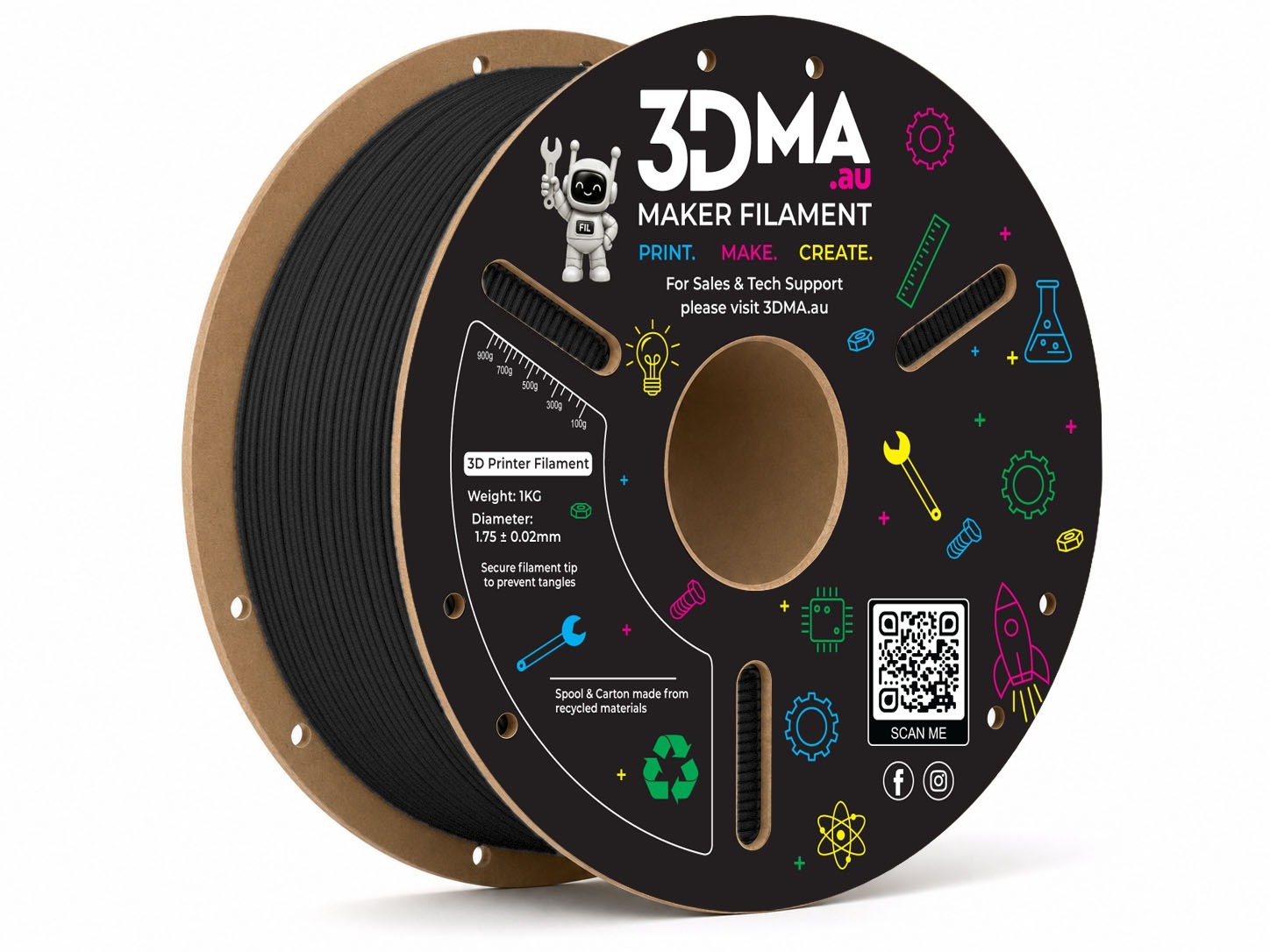
PETG-GF comes in one finish: a matte black with a fine granular surface from the fibre. Layer lines all but vanish, which is unusual for PETG — the unfilled version is glossy and shows every line. A structural part in this material looks moulded rather than printed.
1 colours in this material
Printer compatibility
PETG-GF is 1.75mm 3D printer filament on a standard 1 kg spool, so it fits any FDM printer that takes 1.75 mm and reaches 250 °C at the nozzle — with one hardware requirement: a hardened steel nozzle, 0.6 mm or larger. Many current machines ship with one already; older printers usually need a five-minute swap. The spool label states a diameter tolerance of ±0.02 mm, and the filament tip is secured before packing so the spool does not tangle mid-print.
- Bambu Lab
- Prusa
- Creality
- Elegoo
- Anycubic
- Sovol
- Hardened steel nozzle required
Storage, drying and shelf life
Treat this material the way you would treat PETG-CF: keep it sealed. The combination of a hygroscopic polymer and a fibre that holds moisture against it means a spool left open through a humid week can cost you the layer bonding a structural part depends on.
Every spool ships sealed with desiccant. Keep it that way between prints and drying will not come up. If a spool has been open through a wet season — or if you hear hissing at the nozzle — the manufacturer’s figure is 60 ± 5 °C for 8 hours in a dryer or blast oven, with storage below 20% relative humidity. The storage and drying guide covers what that looks like in practice.
Technical specifications
Preparation Before Printing
- Drying settings (blast drying oven)
- 60 ± 5 °C for 8h
- Printing & storage humidity
- ≤ 20% RH (Sealed with Desiccant)
Recommended Printing Settings
- Nozzle temperature
- 240 - 270 °C
- Bed temperature (with glue)
- 65 - 75 °C
- Printing speed
- < 220 mm/s
Physical Properties
- Density
- 1.29 g/cm³
- Melt index
- 10.3 ± 3.2 g/10 min
- Melting temperature
- 226 °C
- Vicat softening temperature
- 83 °C
- Heat deflection temperature
- 74 °C
Mechanical Properties
- Tensile strength
- 51 ± 8 MPa
- Elongation at break
- 9.6% ± 1.0%
- Bending strength
- 75 ± 2 MPa
- Bending modulus
- 3040 ± 21 MPa
- Impact strength
- 70.7 ± 6.2 kJ/m²
Manufacturer figures for PETG-GF, from PETG / TPU / ABS / ASA Parameters. Test values are measured on standard samples and are for design comparison — real-world results depend on your printer, settings and model.
Common questions about PETG-GF
Should I choose PETG-GF or PETG-CF?
The supplier publishes identical mechanical figures for both grades, so strength is not the deciding factor. Choose glass fibre when the part is near electronics or anywhere an electrically conductive filler would be a liability. Choose carbon fibre otherwise — it is the more familiar material and the one most slicer profiles are written for.
Is glass fibre less abrasive than carbon fibre?
No. Both chew through a brass nozzle, and both need hardened steel at 0.6 mm or larger. If you have been running PETG-CF successfully, the same nozzle handles this.
Is PETG-GF stronger than plain PETG?
On the published numbers, yes. Tensile strength rises from 42 MPa to 51, bending modulus from 2097 MPa to 3040, and heat deflection from 72 °C to 74, with impact strength holding at 70.7 kJ/m². The trade is a slower print, a hardened nozzle and a higher price per spool.
Do I need an enclosure?
No. Like the rest of the PETG family it barely warps, so an open printer is fine.
What nozzle size should I use?
0.6 mm or larger, in hardened steel. The wider opening is not only about wear — a bundle of chopped fibre can bridge a 0.4 mm orifice and stop a print halfway through.
How much can I print from a 1 kg spool?
At PETG-GF’s density of 1.29 g/cm³, a 1 kg spool of 1.75 mm filament holds roughly 320 metres. Structural parts tend to want more walls and higher infill, so a spool goes less far than the same weight of PLA.
Can PETG-GF parts live outdoors?
In the shade, yes. In direct sun, no — neither PETG nor glass fibre offers UV protection, and the part will chalk and embrittle over a season or two. Core ASA is the material built for sun exposure.
Reviews
There are no reviews yet.