
Buy more, save more
- 3–5 rolls 3% off
- 6–9 rolls 6% off
- 10–19 rolls 10% off
- 20+ rolls 15% off
Discount is applied automatically in your cart.
Matte PLA
$17.95
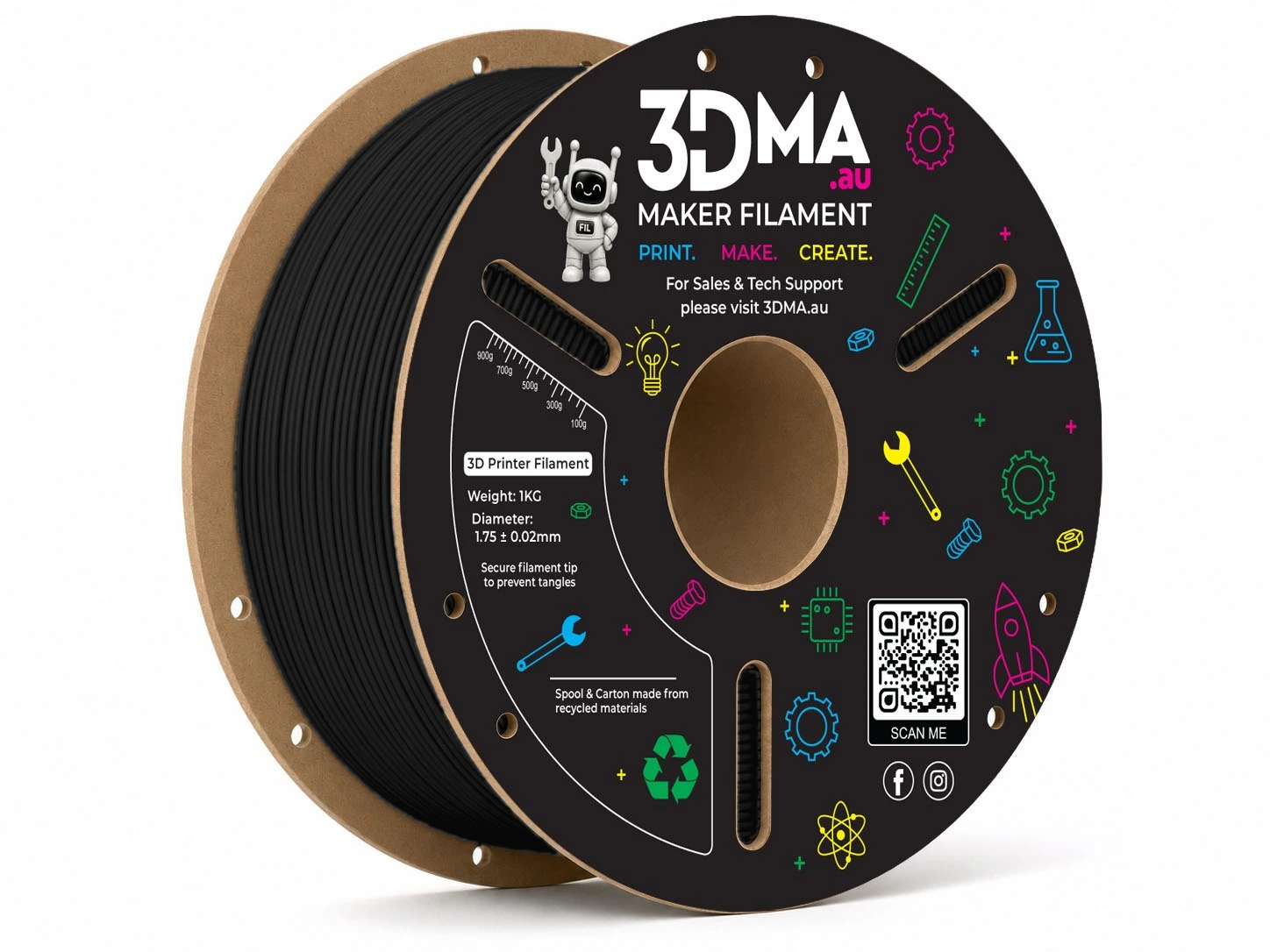
1.75 mm diameter · 1 kg net filament per spool
Matte PLA swaps glossy shine for a soft, velvety finish that hides layer lines and makes prints look moulded rather than printed. The go-to for product models, cosplay and anything that will be photographed or painted.
Printing & drying
- Material
- PLA
- Diameter
- 1.75 mm
- Spool
- 1 kg net
- Nozzle
- 190–230°C
- Bed
- 35–65°C
- Printing speed
- < 300 mm/s
- Part cooling
- High
- Enclosure
- Not required
- Nozzle type
- Standard brass
- Drying
- 50 ± 5°C for 8h
These are typical working ranges for orientation. The label on the spool you receive is authoritative for that batch. More detail in the storage and drying guide and the troubleshooting guide.
Shipping
- Packed and dispatched from Sydney, Australia.
- Every spool ships sealed with desiccant.
- Tracking is provided on every order.
- Buying more than a few spools? Bulk Orders gets you a quote and a supply plan.
Current delivery timeframes are on the Shipping & Returns page.
Returns & warranty
- Backed by the Australian Consumer Law.
- Spool faults are a product fault, not a settings problem. Contact us with your order number and photos.
- Not sure whether it is the spool or the printer? The five-minute triage tells you which half is at fault.
Full terms on the Shipping & Returns page.
Material details
Matte PLA trades gloss for a soft, velvety surface that scatters light instead of reflecting it — and in doing so hides the layer lines that give a print away. A model at an ordinary 0.2 mm layer height reads as though it were printed far finer, or moulded rather than printed at all. It is the finish, not the mechanics, that this filament is bought for.
What Matte PLA is good for
The matte effect comes from a filler that breaks up the surface at a microscopic scale. Because the light never forms a specular highlight, the eye stops tracking the ridges between layers. It is the single cheapest way to make a print look finished, and it costs nothing in printing difficulty — this prints on the same settings as Core PLA.
How Matte PLA prints
The manufacturer’s published window is a nozzle at 190–230 °C and a bed at 35–65 °C with adhesive, at speeds up to 300 mm/s — identical to Core PLA. No enclosure, high part cooling, standard brass nozzle. If you have a PLA profile that works, it works here.
One tuning note worth knowing: print towards the cooler end of the range for the flattest finish. Hotter extrusion lets the surface flow slightly and brings back a faint sheen, which is the opposite of what you bought the material for.
What Matte PLA will not do
Read this before you buy it for the wrong job
Matte PLA is the weakest PLA in this range in tension. Its tensile strength of 30 ± 1 MPa is well under Core PLA’s 38, and its impact strength of 29.3 ± 2.9 kJ/m² is less than half Core PLA’s 66.2. The matting filler interrupts the polymer, and the mechanical properties pay for the finish. This is a material for things that are looked at, not loaded.
It is also PLA for everything else: heat deflection at 55 °C, so a part in a parked car will sag, and no UV resistance, so outdoor pieces chalk over a season. And the matte surface scuffs and marks more readily than gloss — handle finished prints by the edges.
If the part needs to work rather than be admired, the range goes elsewhere:
- Core PLA — tougher, glossy
- PLA+ — functional prints
- Matte PETG — matte that takes load
- Silk PLA — the opposite finish
The Materials Guide has a section on choosing a finish, and sets the mechanical numbers side by side if the part has to do both.
Every colour, one material
Matte PLA carries the widest colour range in the catalogue, and every one of them is the same polymer with the same settings — only the pigment changes. A profile tuned for one carries straight across to the next, and matte colours are unusually good neighbours in a multi-colour print. Each colour is its own tile in the store, so what you click is what arrives.
14 colours in this material
Printer compatibility
Matte PLA is 1.75mm 3D printer filament on a standard 1 kg spool, so it runs on any FDM printer that takes 1.75 mm — Bambu Lab, Prusa, Creality, Elegoo, Anycubic and the rest. Standard brass nozzle, no hardware change, and it feeds through an AMS or other multi-material unit without trouble. The spool label states a diameter tolerance of ±0.02 mm, and the filament tip is secured before packing so the spool does not tangle mid-print.
- Bambu Lab
- Prusa
- Creality
- Elegoo
- Anycubic
- Sovol
- Any 1.75 mm FDM printer
Storage, drying and shelf life
Matte PLA absorbs moisture at roughly the rate plain PLA does, and the symptoms are the same: popping at the nozzle, stringing, and a rough surface. On this material the rough surface matters more than usual, because the finish is the entire point of the purchase.
Every spool ships sealed with desiccant. Keep it that way between prints and drying will not come up. If a spool has been open through a humid season, the manufacturer’s figure is 50 ± 5 °C for 8 hours in a dryer or blast oven, with storage below 20% relative humidity. The storage and drying guide covers what that looks like in practice.
Technical specifications
Preparation Before Printing
- Drying settings (blast drying oven)
- 50 ± 5 °C for 8h
- Printing & storage humidity
- ≤ 20% RH (Sealed with Desiccant)
Recommended Printing Settings
- Nozzle temperature
- 190 - 230 °C
- Bed temperature (with glue)
- 35 - 65 °C
- Printing speed
- < 300 mm/s
Physical Properties
- Density
- 1.26 g/cm³
- Melt index
- 9.4 ± 1.2 g/10 min
- Melting temperature
- 163 °C
- Vicat softening temperature
- 63 °C
- Heat deflection temperature
- 55 °C
Mechanical Properties
- Tensile strength
- 30 ± 1 MPa
- Elongation at break
- 7.9% ± 1.1%
- Bending strength
- 75 ± 3 MPa
- Bending modulus
- 2996 ± 159 MPa
- Impact strength
- 29.3 ± 2.9 kJ/m²
Manufacturer figures for PLA Matte, from PLA Series Parameters. Test values are measured on standard samples and are for design comparison — real-world results depend on your printer, settings and model.
Common questions about Matte PLA
Does matte PLA really hide layer lines?
It hides the appearance of them rather than the lines themselves. The ridges are still there — you can feel them — but without a specular highlight running along each one the eye stops picking them out. At 0.2 mm layers the effect is enough that most people assume a finer layer height was used.
Is matte PLA weaker than regular PLA?
Yes, and by more than most people expect. Tensile strength of 30 MPa against Core PLA’s 38, and impact strength of 29.3 kJ/m² against 66.2 — less than half. The matting filler is what costs it. For anything structural, print in Core PLA or PLA+ instead.
Does it need different settings from normal PLA?
No. Same nozzle range, same bed, same speeds, same cooling. The only adjustment worth making is printing towards the cooler end of the range, which keeps the surface as flat as possible.
Is matte PLA good for painting?
It is the best base in the PLA range. Primer keys into the textured surface rather than sitting on a gloss, so you need less sanding to get an even coat. Cosplay and prop makers use it for exactly this reason.
Why is matte black so popular?
Because it is the closest a desktop printer gets to injection-moulded plastic without any post-processing. Black shows layer lines worse than any other colour in gloss, and matte removes the thing that makes them visible — so the improvement is most dramatic there.
How much can I print from a 1 kg spool?
At Matte PLA’s density of 1.26 g/cm³, a 1 kg spool of 1.75 mm filament holds roughly 330 metres — the same as Core PLA.
Can I get a matte finish in a stronger material?
Yes. Matte PETG gives you the same non-reflective surface on a polymer that handles heat and impact properly, and the composite filaments are naturally matte because of the fibre. Matte PLA is the one to choose when the part is purely visual.
Reviews
There are no reviews yet.