
Buy more, save more
- 3–5 rolls 3% off
- 6–9 rolls 6% off
- 10–19 rolls 10% off
- 20+ rolls 15% off
Discount is applied automatically in your cart.
Marble PLA
$22.95
1.75 mm diameter · 1 kg net filament per spool
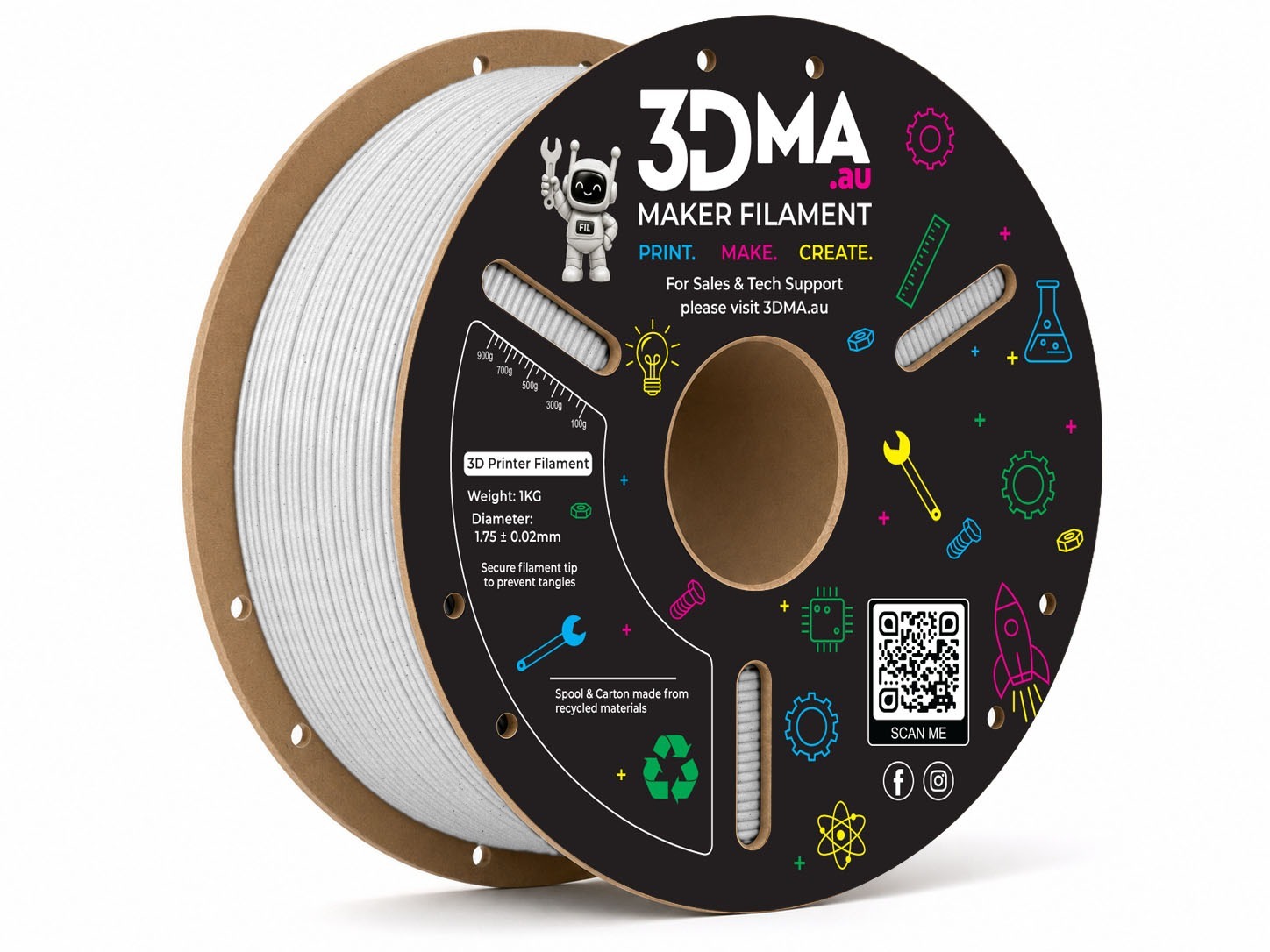
Marble PLA scatters dark speckle through a stone-white base, so busts, statues and planters come off the printer looking carved rather than printed. It also hides layer lines beautifully.
Printing & drying
- Material
- PLA
- Diameter
- 1.75 mm
- Spool
- 1 kg net
- Nozzle
- 190–220°C
- Bed
- 35–65°C
- Printing speed
- < 200 mm/s
- Part cooling
- High
- Enclosure
- Not required
- Nozzle type
- Standard brass
- Drying
- 50 ± 5°C for 8h
These are typical working ranges for orientation. The label on the spool you receive is authoritative for that batch. More detail in the storage and drying guide and the troubleshooting guide.
Shipping
- Packed and dispatched from Sydney, Australia.
- Every spool ships sealed with desiccant.
- Tracking is provided on every order.
- Buying more than a few spools? Bulk Orders gets you a quote and a supply plan.
Current delivery timeframes are on the Shipping & Returns page.
Returns & warranty
- Backed by the Australian Consumer Law.
- Spool faults are a product fault, not a settings problem. Contact us with your order number and photos.
- Not sure whether it is the spool or the printer? The five-minute triage tells you which half is at fault.
Full terms on the Shipping & Returns page.
Material details
Marble PLA does two things at once: it convincingly imitates natural stone, and its random speckle completely camouflages layer lines. Even at coarse layer heights a marble print reads as a solid sculpted object rather than a printed one — which is why it is the default for classical busts and museum-style pieces. It is also, on the published numbers, the most ductile PLA in the range.
What Marble PLA is good for
The speckle runs randomly through the filament, so no two prints are patterned identically — each piece is genuinely unique in a way that flat colour cannot be. That randomness is also what hides the layers: there is no regular feature for the eye to lock onto, so the horizontal banding a print normally shows simply disappears into the stone.
How Marble PLA prints
The manufacturer’s published window is a nozzle at 190–220 °C and a bed at 35–65 °C with adhesive, at speeds up to 200 mm/s. The narrower nozzle range and lower speed ceiling are typical of a particle-filled filament. No enclosure, high part cooling, standard brass nozzle.
The practical advantage of this material is that you can print it coarsely. A 0.28 mm layer height on a bust would normally look obviously stepped; in marble it reads as stone texture. That turns a twelve-hour print into a seven-hour one with no visible cost.
What Marble PLA will not do
Read this before you buy it for the wrong job
It is stone-look, not stone. A marble print weighs what PLA weighs — 1.23 g/cm³ — so a bust that looks like it should be heavy feels conspicuously light when you pick it up. Some makers fill the base with sand or plaster for exactly this reason.
And it is still PLA outdoors: heat deflection at 57 °C and no UV resistance, so a garden planter will chalk and eventually distort through an Australian summer. Indoors, out of direct sun, it lasts indefinitely.
If the piece has to live outside or carry load, the range goes elsewhere:
- ASA — outdoor planters & statuary
- PETG — shaded outdoors
- Matte PLA — flat colour, same line-hiding
- Core PLA — plain white
The Materials Guide sets the decorative PLAs side by side with the published numbers.
The finish
Marble PLA comes in one finish, and it is what the material is for: a stone-white base with dark speckle running randomly through it. Because the pattern is in the filament rather than on the surface, sanding a piece reveals more of the same stone underneath rather than stripping the effect off.
1 colours in this material
Printer compatibility
Marble PLA is 1.75mm 3D printer filament on a standard 1 kg spool, so it runs on any FDM printer that takes 1.75 mm — Bambu Lab, Prusa, Creality, Elegoo, Anycubic and the rest. A standard 0.4 mm brass nozzle is fine; hardened steel is the sensible choice for heavy use. The spool label states a diameter tolerance of ±0.02 mm, and the filament tip is secured before packing so the spool does not tangle mid-print.
- Bambu Lab
- Prusa
- Creality
- Elegoo
- Anycubic
- Sovol
- Any 1.75 mm FDM printer
Storage, drying and shelf life
Marble PLA absorbs moisture at about the rate plain PLA does. A damp spool prints with a furry surface, which on this material muddles the speckle into a general haze instead of leaving distinct stone flecks.
Every spool ships sealed with desiccant. Keep it that way between prints and drying will not come up. If a spool has been open through a humid season, the manufacturer’s figure is 50 ± 5 °C for 8 hours in a dryer or blast oven, with storage below 20% relative humidity. The storage and drying guide covers what that looks like in practice.
Technical specifications
Preparation Before Printing
- Drying settings (blast drying oven)
- 50 ± 5 °C for 8h
- Printing & storage humidity
- ≤ 20% RH (Sealed with Desiccant)
Recommended Printing Settings
- Nozzle temperature
- 190 - 220 °C
- Bed temperature (with glue)
- 35 - 65 °C
- Printing speed
- < 200 mm/s
Physical Properties
- Density
- 1.23 g/cm³
- Melt index
- 14.7 ± 1.4 g/10 min
- Melting temperature
- 158 °C
- Vicat softening temperature
- 62 °C
- Heat deflection temperature
- 57 °C
Mechanical Properties
- Tensile strength
- 40 ± 2 MPa
- Elongation at break
- 14.9% ± 1%
- Bending strength
- 72 ± 3 MPa
- Bending modulus
- 2512 ± 137 MPa
- Impact strength
- 63.2 ± 3.2 kJ/m²
Manufacturer figures for PLA Marble, from PLA Series Parameters. Test values are measured on standard samples and are for design comparison — real-world results depend on your printer, settings and model.
Common questions about Marble PLA
Does it really hide layer lines?
Better than anything else in the range. The speckle is random, so there is no repeating feature for the eye to lock onto and the horizontal banding stops registering. You can print a bust at 0.28 mm and most people will not be able to tell.
Will every print look the same?
No, and that is part of the appeal. The speckle is distributed randomly along the filament, so each print lands on a different stretch of pattern. Two copies of the same model from the same spool will not be identical.
Does it feel like stone?
It looks like stone and weighs like plastic. At 1.23 g/cm³ a marble print is as light as any other PLA, which can be a jarring contrast when someone picks up a piece that looks solid. Weighting the base with sand or plaster is a common fix for display pieces.
Is Marble PLA brittle?
Less than most. Its elongation at break of 14.9% is the highest of any PLA in this range — noticeably more forgiving than Core PLA’s 10.5% — and its impact strength of 63.2 kJ/m² is close behind Core PLA’s. For a decorative filament it is unusually robust.
Can I sand and polish it?
Yes, and it responds well. Because the pattern runs through the material rather than sitting on the surface, sanding exposes more stone rather than removing the effect. Progressive grits give a smooth, semi-polished finish that reads convincingly as worked stone.
Do I need a hardened nozzle?
Not for occasional use — a standard 0.4 mm brass nozzle handles it. Like every particle-filled filament it will wear brass faster than plain PLA over sustained heavy printing, so hardened steel is worth fitting if marble becomes a staple.
How much can I print from a 1 kg spool?
At a density of 1.23 g/cm³, a 1 kg spool of 1.75 mm filament holds roughly 340 metres. Busts and sculpture are usually printed hollow or at low infill, so a spool covers several substantial pieces.
Reviews
There are no reviews yet.