
Buy more, save more
- 3–5 rolls 3% off
- 6–9 rolls 6% off
- 10–19 rolls 10% off
- 20+ rolls 15% off
Discount is applied automatically in your cart.
Glitter PLA
$24.95
1.75 mm diameter · 1 kg net filament per spool
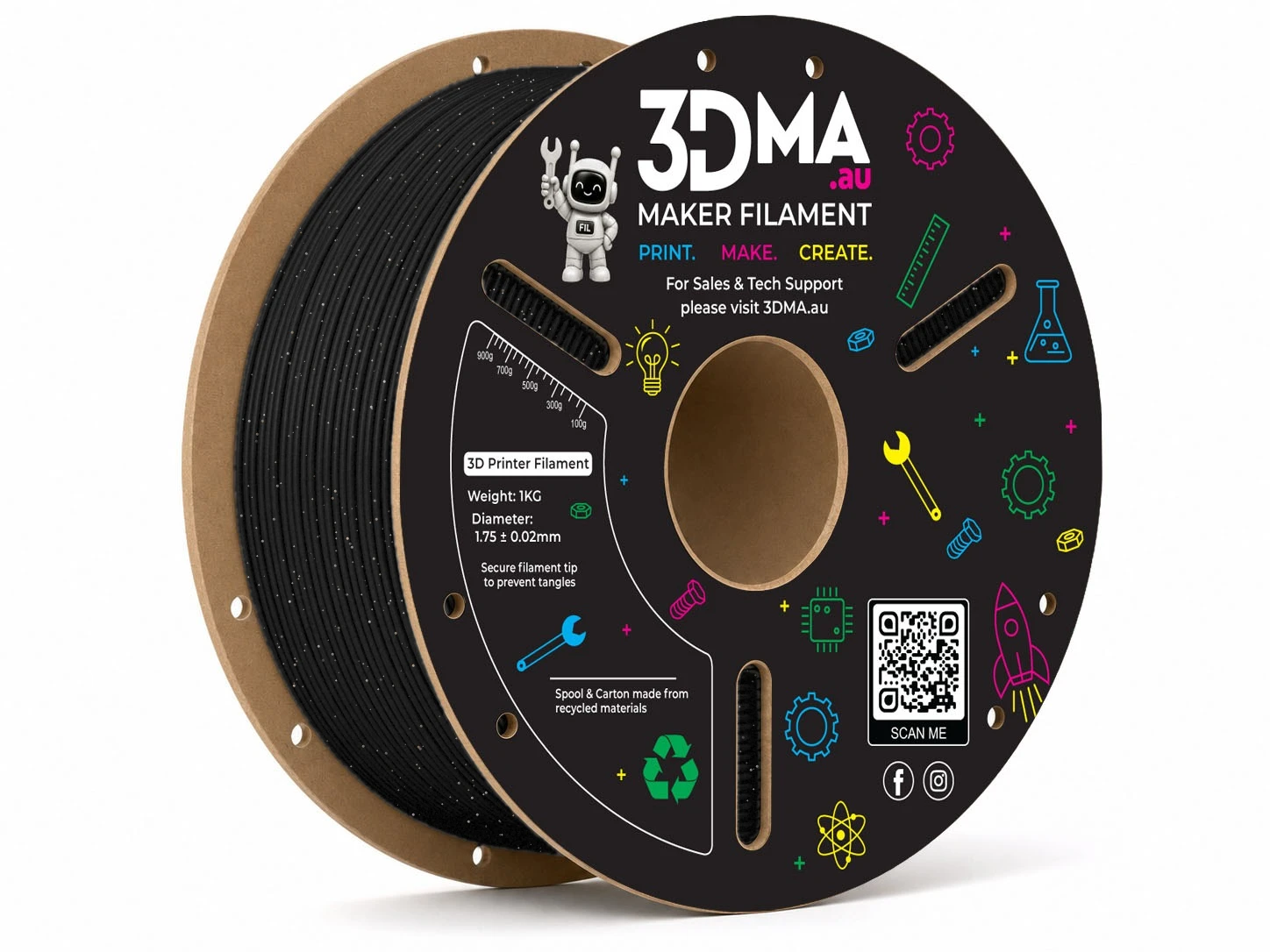
Glitter PLA adds visible, light-catching sparkle to easy PLA printing — with zero craft-glitter mess. Gifts, ornaments and decorations come off the plate already glittering, no paint required.
Printing & drying
- Material
- PLA
- Diameter
- 1.75 mm
- Spool
- 1 kg net
- Nozzle
- 190–220°C
- Bed
- 35–65°C
- Printing speed
- < 200 mm/s
- Part cooling
- High
- Enclosure
- Not required
- Nozzle type
- Standard brass
- Drying
- 50 ± 5°C for 8h
These are typical working ranges for orientation. The label on the spool you receive is authoritative for that batch. More detail in the storage and drying guide and the troubleshooting guide.
Shipping
- Packed and dispatched from Sydney, Australia.
- Every spool ships sealed with desiccant.
- Tracking is provided on every order.
- Buying more than a few spools? Bulk Orders gets you a quote and a supply plan.
Current delivery timeframes are on the Shipping & Returns page.
Returns & warranty
- Backed by the Australian Consumer Law.
- Spool faults are a product fault, not a settings problem. Contact us with your order number and photos.
- Not sure whether it is the spool or the printer? The five-minute triage tells you which half is at fault.
Full terms on the Shipping & Returns page.
Material details
Glitter PLA locks the full glitter effect inside the filament, so you get sparkle everywhere on the print and nowhere on your bench. The particles are bonded into the polymer during manufacture — they cannot shed, rub off or end up in the carpet. It is the seasonal and craft filament of the range, and it hides layer lines while it is at it.
What Glitter PLA is good for
This is a bolder effect than Nebula’s fine micro-sparkle: larger, more visible flakes that catch the light individually rather than suggesting depth. Darker base colours make the sparkle pop hardest, which is why black and deep green are the two most-printed options in almost every glitter range.
How Glitter PLA prints
The manufacturer’s published window is a nozzle at 190–220 °C and a bed at 35–65 °C with adhesive, at speeds up to 200 mm/s. Both the nozzle range and the speed ceiling are narrower than Core PLA’s, which is normal for a particle-filled filament — the flakes thicken the melt and reward a steadier pace.
A 0.4 mm brass nozzle handles the glitter without trouble for normal use. As with every filled filament, sustained heavy printing will wear brass faster than plain PLA would — if Glitter becomes a staple, fit a hardened steel nozzle and stop thinking about it.
What Glitter PLA will not do
Read this before you buy it for the wrong job
It is still PLA where the environment is concerned: heat deflection at 57 °C and no meaningful UV resistance. An ornament in a sunny window will fade over a season or two, and a part left in a car in summer will sag.
The sparkle also depends on light hitting it directly, so it is at its least impressive in a shadowed corner or under diffuse lighting. And on very fine detail the flakes can sit proud of a thin feature, softening crisp edges — large, simple forms show it best.
If the piece needs to do more than sparkle, the range goes elsewhere:
- Nebula PLA — finer, deeper sparkle
- Silk PLA — gloss instead
- Core PLA — plain and tough
- ASA — outdoor decorations
The Materials Guide sets the decorative PLAs side by side with the published numbers.
Every colour, one material
Every Glitter colour is the same polymer with the same settings — only the base pigment changes, and the glitter loading stays the same across them. Darker bases show the sparkle most strongly. Each colour is its own tile in the store, so what you click is what arrives.
Printer compatibility
Glitter PLA is 1.75mm 3D printer filament on a standard 1 kg spool, so it runs on any FDM printer that takes 1.75 mm — Bambu Lab, Prusa, Creality, Elegoo, Anycubic and the rest. A standard 0.4 mm brass nozzle is fine; hardened steel is the sensible choice for heavy use. The spool label states a diameter tolerance of ±0.02 mm, and the filament tip is secured before packing so the spool does not tangle mid-print.
- Bambu Lab
- Prusa
- Creality
- Elegoo
- Anycubic
- Sovol
- Any 1.75 mm FDM printer
Storage, drying and shelf life
A damp spool costs you the finish. Moisture roughens the surface, and a rough surface scatters light everywhere instead of letting individual flakes catch it, so a wet print looks flat rather than obviously faulty.
Every spool ships sealed with desiccant. Keep it that way between prints and drying will not come up. If a spool has been open through a humid season, the manufacturer’s figure is 50 ± 5 °C for 8 hours in a dryer or blast oven, with storage below 20% relative humidity. The storage and drying guide covers what that looks like in practice.
Technical specifications
Preparation Before Printing
- Drying settings (blast drying oven)
- 50 ± 5 °C for 8h
- Printing & storage humidity
- ≤ 20% RH (Sealed with Desiccant)
Recommended Printing Settings
- Nozzle temperature
- 190 - 220 °C
- Bed temperature (with glue)
- 35 - 65 °C
- Printing speed
- < 200 mm/s
Physical Properties
- Density
- 1.23 g/cm³
- Melt index
- 14.7 ± 1.4 g/10 min
- Melting temperature
- 158 °C
- Vicat softening temperature
- 62 °C
- Heat deflection temperature
- 57 °C
Mechanical Properties
- Tensile strength
- 43 ± 3 MPa
- Elongation at break
- 7.6% ± 0.7%
- Bending strength
- 72 ± 2 MPa
- Bending modulus
- 2773 ± 92 MPa
- Impact strength
- 59.8 ± 4.9 kJ/m²
Manufacturer figures for PLA Sparkle, from PLA Series Parameters. Test values are measured on standard samples and are for design comparison — real-world results depend on your printer, settings and model.
Common questions about Glitter PLA
Will the glitter come off?
No. The particles are bonded into the filament during manufacture, not applied to the surface. That is the whole point of printing glitter rather than gluing it on — the sparkle is permanent and the bench stays clean.
Do I need a special nozzle?
Not for occasional use. A standard 0.4 mm brass nozzle handles the flakes fine. Over sustained heavy printing the particles will wear brass faster than unfilled PLA, so a hardened steel nozzle is worth fitting if this becomes a regular material.
Does it hide layer lines?
Yes. Like all particle-filled filaments it interrupts the eye, so prints at coarser layer heights still look finished. For a batch of ornaments printed quickly, that is a real saving.
Which colours show the sparkle best?
Darker bases. Against black or deep green the flakes read as individual points of light; against a pale base they compete with the background and the effect softens. All three colours carry the same glitter loading.
Is Glitter PLA strong enough for a handled piece?
For a decorative PLA, yes. Its impact strength of 59.8 kJ/m² is close to Core PLA’s 66.2 and far ahead of Silk or Matte. A trinket dish or a desk piece that gets picked up daily is well within it — a load-bearing bracket is not.
How much can I print from a 1 kg spool?
At a density of 1.23 g/cm³, a 1 kg spool of 1.75 mm filament holds roughly 340 metres. Ornaments and small gifts use very little each, so a spool goes a long way through a season.
Can I print it at a chunky layer height to save time?
Yes, and it is one of the better materials for it. The sparkle disguises the coarser layers, so a batch printed at 0.28 mm still looks deliberate. Just stay inside the 200 mm/s ceiling.
Reviews
There are no reviews yet.