
Buy more, save more
- 3–5 rolls 3% off
- 6–9 rolls 6% off
- 10–19 rolls 10% off
- 20+ rolls 15% off
Discount is applied automatically in your cart.
Dual-Silk PLA
$22.95
1.75 mm diameter · 1 kg net filament per spool
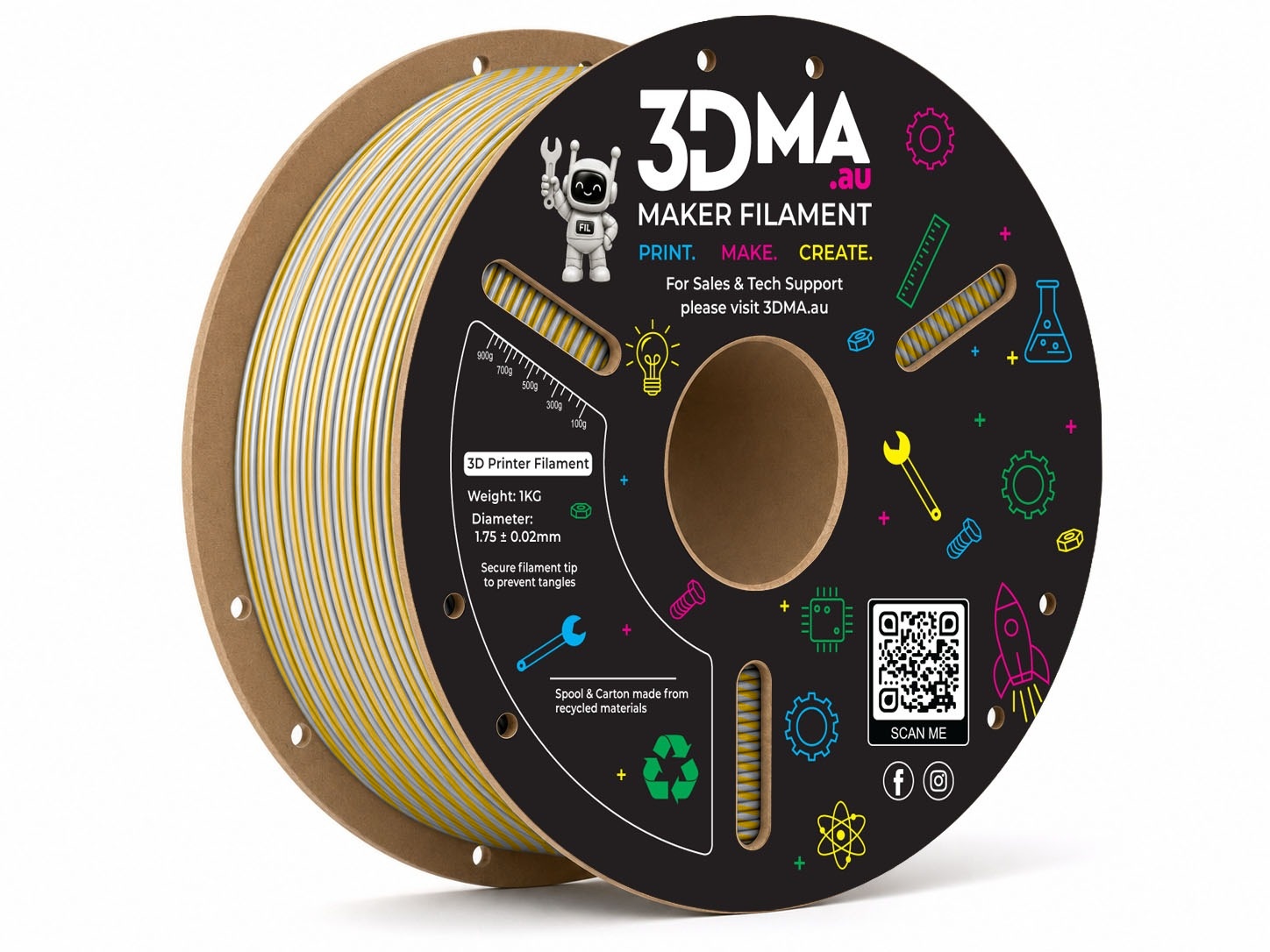
Dual-Silk PLA runs two glossy silk colours through one strand, so every curve of your print shows a different blend. One model, two colours, endlessly shifting as you turn it.
Printing & drying
- Material
- PLA
- Diameter
- 1.75 mm
- Spool
- 1 kg net
- Nozzle
- 190–230°C
- Bed
- 35–65°C
- Printing speed
- < 220 mm/s
- Part cooling
- High
- Enclosure
- Not required
- Nozzle type
- Standard brass
- Drying
- 50 ± 5°C for 8h
These are typical working ranges for orientation. The label on the spool you receive is authoritative for that batch. More detail in the storage and drying guide and the troubleshooting guide.
Shipping
- Packed and dispatched from Sydney, Australia.
- Every spool ships sealed with desiccant.
- Tracking is provided on every order.
- Buying more than a few spools? Bulk Orders gets you a quote and a supply plan.
Current delivery timeframes are on the Shipping & Returns page.
Returns & warranty
- Backed by the Australian Consumer Law.
- Spool faults are a product fault, not a settings problem. Contact us with your order number and photos.
- Not sure whether it is the spool or the printer? The five-minute triage tells you which half is at fault.
Full terms on the Shipping & Returns page.
Material details
Dual-Silk PLA is manufactured with two colours running parallel down the strand. As the printer moves around a model, each face picks up a different side of the filament — so the part shades from one colour to the other across its own geometry, with no slicer tricks and no multi-material hardware. One nozzle, one spool, two colours.
What Dual-Silk PLA is good for
The effect depends entirely on movement. On a flat box you get two stripes; on something curved and twisting, the colours chase each other around the form and the piece appears to change as you walk past it. It is the single easiest way to make a print look far more complex than it was to produce.
How Dual-Silk PLA prints
The manufacturer’s published window is a nozzle at 190–230 °C and a bed at 35–65 °C with adhesive, at speeds up to 220 mm/s — the silk PLA envelope, and the speed ceiling matters. Treat it as silk first and a two-colour material second: run the nozzle warm, ease part cooling back, and keep the outer wall slow so the surface levels into a proper sheen.
Where the colours land is decided by how the model sits on the plate. Rotating the part in your slicer changes which surfaces catch which colour, and it costs nothing to try two orientations on a small test before committing to a twelve-hour dragon.
What Dual-Silk PLA will not do
Read this before you buy it for the wrong job
This is silk PLA, and it carries silk PLA’s mechanical numbers: a tensile strength of 26 ± 3 MPa and an impact strength of 25.5 ± 2.2 kJ/m², the lowest published figures in the catalogue. Layer adhesion is decorative-grade. Do not print anything load-bearing in it.
You also do not get to choose exactly where the colours go. The transition follows the model’s geometry and its orientation on the plate, not your intent — if you need deliberate colour placement, that is a multi-material job. And its heat deflection of 54 °C is the lowest of any PLA here.
If you need control or strength, the range goes elsewhere:
- Tri-Silk — three colours
- Rainbow-Silk — shifts up the print
- Silk PLA — single colour, same gloss
- Core PLA — tough and plain
The Materials Guide sets the decorative PLAs side by side with the published numbers.
Every combination, one material
Both Dual-Silk combinations are the same polymer with the same settings — only the pair of colours changes. A profile tuned for one carries straight across to the other. Each combination is its own tile in the store, so what you click is what arrives.
2 colours in this material
Printer compatibility
Dual-Silk PLA is 1.75mm 3D printer filament on a standard 1 kg spool, so it runs on any FDM printer that takes 1.75 mm — Bambu Lab, Prusa, Creality, Elegoo, Anycubic and the rest. Standard brass nozzle, no hardware change, and it needs no multi-material unit: the two colours are in the strand. The spool label states a diameter tolerance of ±0.02 mm, and the filament tip is secured before packing so the spool does not tangle mid-print.
- Bambu Lab
- Prusa
- Creality
- Elegoo
- Anycubic
- Sovol
- Any 1.75 mm FDM printer
Storage, drying and shelf life
Moisture flattens the sheen before it does anything more obvious. Water in the melt produces micro-bubbles that scatter light at exactly the scale silk depends on, so a damp spool prints a piece that looks dull and patchy rather than faulty — which makes it easy to blame the slicer instead.
Every spool ships sealed with desiccant. Keep it that way between prints and drying will not come up. If a spool has been open through a humid season, the manufacturer’s figure is 50 ± 5 °C for 8 hours in a dryer or blast oven, with storage below 20% relative humidity. The storage and drying guide covers what that looks like in practice.
Technical specifications
Preparation Before Printing
- Drying settings (blast drying oven)
- 50 ± 5 °C for 8h
- Printing & storage humidity
- ≤ 20% RH (Sealed with Desiccant)
Recommended Printing Settings
- Nozzle temperature
- 190 - 230 °C
- Bed temperature (with glue)
- 35 - 65 °C
- Printing speed
- < 220 mm/s
Physical Properties
- Density
- 1.25 g/cm³
- Melt index
- 28.7 ± 2.1 g/10 min
- Melting temperature
- 164 °C
- Vicat softening temperature
- 58 °C
- Heat deflection temperature
- 54 °C
Mechanical Properties
- Tensile strength
- 26 ± 3 MPa
- Elongation at break
- 9.7% ± 2.3%
- Bending strength
- 79 ± 2 MPa
- Bending modulus
- 2816 ± 136 MPa
- Impact strength
- 25.5 ± 2.2 kJ/m²
Manufacturer figures for PLA Silk, from PLA Series Parameters. Test values are measured on standard samples and are for design comparison — real-world results depend on your printer, settings and model.
Common questions about Dual-Silk PLA
Do I need a multi-material printer?
No. Both colours are in the single strand, side by side. One nozzle, one spool, no AMS, no tool changer, no purge waste — which is most of the appeal.
Can I control which colour goes where?
Only indirectly. The colours land according to the model’s geometry and how it is oriented on the plate, so rotating the part changes the result. Print a small test at two orientations before committing to a long print if placement matters to you.
Why does my print look striped rather than blended?
Flat, angular geometry. The blend comes from the extrusion direction changing as the nozzle travels around a curve; a model made of flat faces gives it nothing to work with. Curved, twisting or spiral models are what this material is for.
Is it as strong as normal PLA?
No. It shares silk PLA’s figures — 26 MPa tensile and 25.5 kJ/m² impact strength, the lowest in the catalogue, with decorative-grade layer adhesion. Print anything functional in Core PLA or PLA+.
How do I get the best gloss?
Run the nozzle towards 230 °C, keep inside the 220 mm/s ceiling, slow the outer wall, and reduce part cooling. Silk needs a moment longer in the melt to level out; cold and fast is why some silk prints come out dull.
How much can I print from a 1 kg spool?
At a density of 1.25 g/cm³, a 1 kg spool of 1.75 mm filament holds roughly 335 metres. Vases and flexi prints use very little material for their size, so a spool covers a lot of them.
Does it work in vase mode?
It is arguably the best use of it. A single continuous wall with no seams gives the two colours an uninterrupted spiral to blend along, and there is no layer-adhesion demand to worry about on a piece with no load.
Reviews
There are no reviews yet.