
Buy more, save more
- 3–5 rolls 3% off
- 6–9 rolls 6% off
- 10–19 rolls 10% off
- 20+ rolls 15% off
Discount is applied automatically in your cart.
Core PLA
$14.95
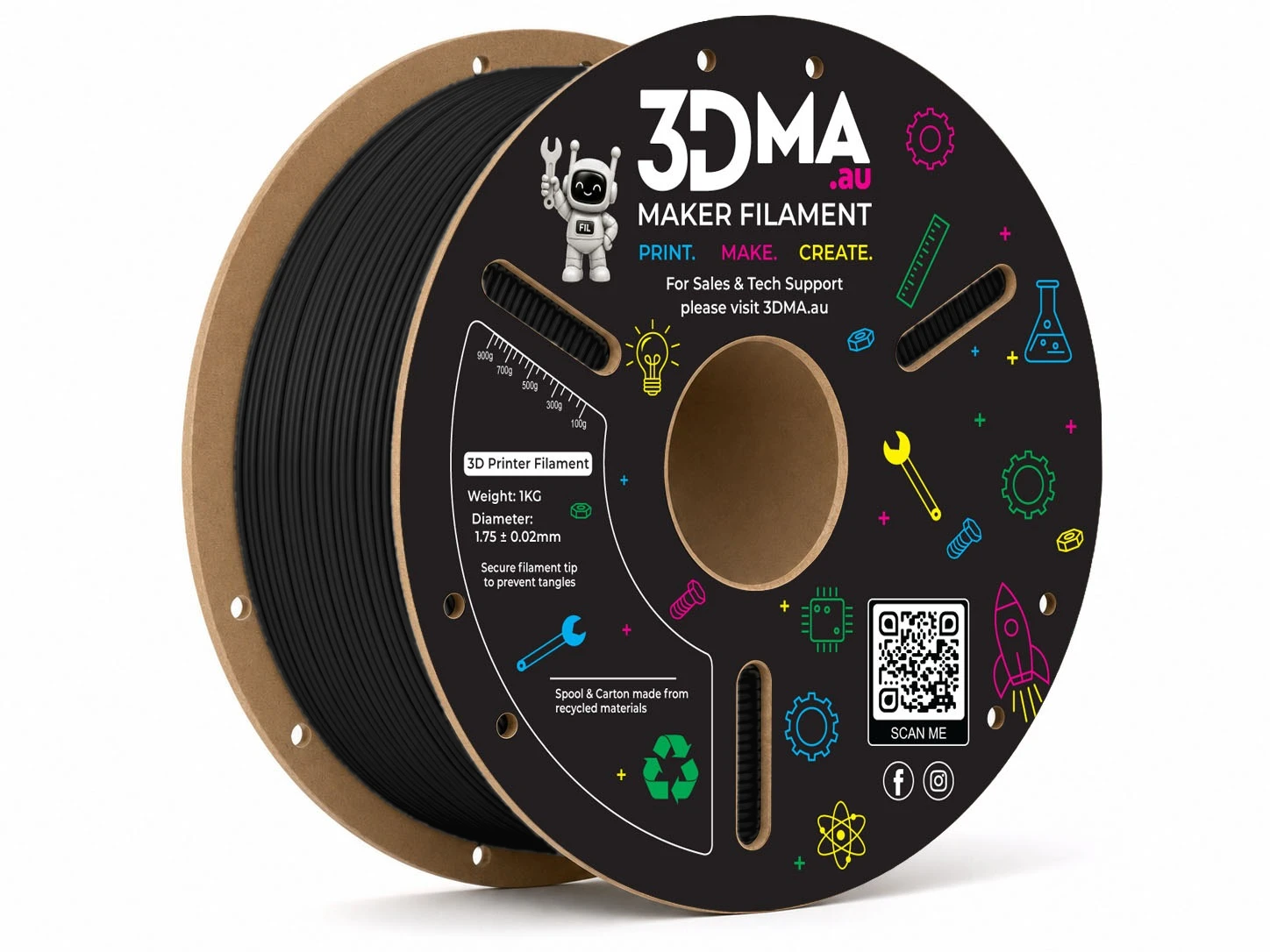
1.75 mm diameter · 1 kg net filament per spool
The everyday workhorse of the 3DMA range. Core PLA is the easy-printing, great-looking filament every maker reaches for first — clean detail, no warping, no enclosure, no fuss. Ideal for models, prototypes, classroom prints and general making.
Printing & drying
- Material
- PLA
- Diameter
- 1.75 mm
- Spool
- 1 kg net
- Nozzle
- 190–230°C
- Bed
- 35–65°C
- Printing speed
- < 300 mm/s
- Part cooling
- High
- Enclosure
- Not required
- Nozzle type
- Standard brass
- Drying
- 50 ± 5°C, 8h
These are typical working ranges for orientation. The label on the spool you receive is authoritative for that batch. More detail in the storage and drying guide and the troubleshooting guide.
Shipping
- Packed and dispatched from Sydney, Australia.
- Every spool ships sealed with desiccant.
- Tracking is provided on every order.
- Buying more than a few spools? Bulk Orders gets you a quote and a supply plan.
Current delivery timeframes are on the Shipping & Returns page.
Returns & warranty
- Backed by the Australian Consumer Law.
- Spool faults are a product fault, not a settings problem. Contact us with your order number and photos.
- Not sure whether it is the spool or the printer? The five-minute triage tells you which half is at fault.
Full terms on the Shipping & Returns page.
Material details
Core PLA is the PLA filament almost every maker learns on, and the one most keep coming back to. It prints at low temperatures, barely warps, needs no enclosure, and sticks happily to almost any build surface — which is why it is the default choice for models, prototypes, classroom work and anything that lives indoors.
What Core PLA is good for
PLA is a plant-derived thermoplastic that melts at a low temperature and sets quickly, which makes it forgiving in a way no other common 3D printing filament is. It does not need a heated chamber, it rarely lifts off the bed, and it holds fine detail without stringing across gaps. If a print fails in PLA, the cause is usually the model or the first layer — not the material fighting you.
How Core PLA prints
The manufacturer’s published window is a nozzle at 190–230 °C and a bed at 35–65 °C with adhesive, at speeds up to 300 mm/s. In practice most printers land near the middle of that range and stay there. Part cooling should be high — PLA benefits from as much fan as your printer can give it, which is the opposite of what ABS and ASA want.
No enclosure, no hardened nozzle, no special build surface. Standard brass is fine, because unfilled PLA carries nothing abrasive. If you are printing your first spool, the first-spool guide walks through the three faults that account for most early failures.
What Core PLA will not do
Read this before you buy it for the wrong job
PLA has a heat deflection temperature of 57 °C and a Vicat softening point of 62 °C. Those numbers matter in Australia more than almost anywhere: a car parked in the sun on a 30 °C day reaches well above that inside, so a PLA part left on a dashboard will sag.
PLA is also comparatively brittle. At 10.5% elongation at break it will snap rather than bend, so it is a poor choice for clips, living hinges, brackets under load, or anything that gets dropped. And it has no meaningful UV resistance, so outdoor parts will chalk and embrittle over a season.
If any of those apply, the material you want is on the other side of the range:
- PETG — outdoor & semi-functional
- ASA — Australian sun
- ABS — heat resistance
- TPU — needs to flex
- PLA+ — tougher PLA
The Materials Guide compares all five side by side, and PLA vs PLA+ covers the middle ground if you want the same easy printing with more toughness.
Every colour, one material
Every colour of this PLA filament is the same polymer with the same settings — only the pigment changes. That means a multi-colour print will not need per-colour tuning, and a colour you liked last year behaves the same way this year. Each colour is its own tile in the store, so what you click is what arrives.
19 colours in this material
Printer compatibility
Core PLA is 1.75mm 3D printer filament on a standard 1 kg spool, so it runs on any FDM printer that takes 1.75 mm — Bambu Lab, Prusa, Creality, Elegoo, Anycubic and the rest. The spool label states a diameter tolerance of ±0.02 mm, which is what keeps extrusion consistent from the first metre to the last, and the filament tip is secured before packing so the spool does not tangle mid-print.
- Bambu Lab
- Prusa
- Creality
- Elegoo
- Anycubic
- Sovol
- Any 1.75 mm FDM printer
Storage, drying and shelf life
PLA absorbs moisture from the air more slowly than PETG or nylon, but it does absorb it — and a humid east-coast summer will get there faster than most people expect. Wet PLA filament pops and crackles at the nozzle, strings between features, and prints with a rough, furry surface.
Every spool ships sealed with desiccant. Keep it that way between prints and you will not need to dry it. If a spool has been open on the shelf through a wet season, the manufacturer’s figure is 50 ± 5 °C for 8 hours in a dryer or blast oven, and storage below 20% relative humidity. The storage and drying guide covers what that looks like in practice, including which storage options are worth the money.
Technical specifications
Preparation Before Printing
- Drying settings (blast drying oven)
- 50 ± 5 °C, 8h
- Printing & storage humidity
- ≤ 20% RH (Sealed with Desiccant)
Recommended Printing Settings
- Nozzle temperature
- 190 - 230 °C
- Bed temperature (with glue)
- 35 - 65 °C
- Printing speed
- < 300 mm/s
Physical Properties
- Density
- 1.26 g/cm³
- Melt index
- 8.1 ± 1.5 g/10 min
- Melting temperature
- 158 °C
- Vicat softening temperature
- 62 °C
- Heat deflection temperature
- 57 °C
Mechanical Properties
- Tensile strength
- 38 ± 3 MPa
- Elongation at break
- 10.5% ± 2.1%
- Bending strength
- 72 ± 5 MPa
- Bending modulus
- 2993 ± 182 MPa
- Impact strength
- 66.2 ± 3.9 kJ/m²
Manufacturer figures for PLA, from PLA Series Parameters. Test values are measured on standard samples and are for design comparison — real-world results depend on your printer, settings and model.
Common questions about Core PLA
Is Core PLA a good first spool?
It is the one we would hand any hobbyist starting out. It prints cooler than every other common filament, tolerates a badly tuned bed better, and does not need an enclosure or a hardened nozzle. Almost every early print failure in PLA traces back to bed levelling or first-layer height rather than the material — which means you learn the printer, not a workaround.
Will Core PLA work with my printer?
If your printer takes 1.75 mm filament, yes. That covers Bambu Lab, Prusa, Creality, Elegoo, Anycubic, Sovol and effectively every current desktop FDM machine. No firmware change, no hardware swap, standard brass nozzle.
How much can I print from a 1 kg spool?
At PLA’s density of 1.26 g/cm³, a 1 kg spool of 1.75 mm filament holds roughly 330 metres. What that turns into depends entirely on your models — as a rough feel, a palm-sized figurine at standard infill lands around 25–40 g, so a spool covers a lot of them.
Is PLA strong enough for functional parts?
Stronger than most people assume in one direction and weaker in another. Its tensile strength of 38 ± 3 MPa is higher than ABS, so a PLA part resists being pulled apart well. But at 10.5% elongation at break it is brittle — it snaps instead of bending. For parts that flex, get knocked, or carry sustained load, PETG or ABS will serve you better.
Should I buy PLA or PETG?
Print it in PLA if it lives indoors, looks good, and does not take load. Print it in PETG if it goes outside, gets warm, or needs to survive being dropped. PETG costs a little more and is fussier to tune, which is why PLA filament remains the default for everything that does not specifically need the extra. The Materials Guide sets the two against each other with the numbers.
Do I need to dry Core PLA before printing?
Not if the spool is fresh or has been kept sealed with its desiccant. Dry it if it has sat open through a humid summer, or if you hear popping and crackling at the nozzle and see stringing that was not there before. The manufacturer’s figure is 50 ± 5 °C for 8 hours.
Is it safe to print indoors?
PLA prints at lower temperatures than ABS or ASA and does not produce the styrene smell those materials are known for, which is why it is the material of choice for classrooms and home offices. Sensible ventilation is still worth having for any 3D printing. Our guide for Australian schools covers the ventilation rules per material in more detail.
Reviews
There are no reviews yet.