
Buy more, save more
- 3–5 rolls 3% off
- 6–9 rolls 6% off
- 10–19 rolls 10% off
- 20+ rolls 15% off
Discount is applied automatically in your cart.
Core ASA
$23.95
1.75 mm diameter · 1 kg net filament per spool
Core ASA is the outdoor specialist: all the toughness and heat resistance of ABS, plus genuine UV stability. The material to choose for parts that live under the Australian sun.
Printing & drying
- Material
- ASA
- Diameter
- 1.75 mm
- Spool
- 1 kg net
- Nozzle
- 240–270°C
- Bed
- 90–100°C
- Printing speed
- < 220 mm/s
- Part cooling
- Off or minimal
- Enclosure
- Required, with ventilation
- Nozzle type
- Standard brass
- Drying
- 80 ± 5°C for 8h
These are typical working ranges for orientation. The label on the spool you receive is authoritative for that batch. More detail in the storage and drying guide and the troubleshooting guide.
Shipping
- Packed and dispatched from Sydney, Australia.
- Every spool ships sealed with desiccant.
- Tracking is provided on every order.
- Buying more than a few spools? Bulk Orders gets you a quote and a supply plan.
Current delivery timeframes are on the Shipping & Returns page.
Returns & warranty
- Backed by the Australian Consumer Law.
- Spool faults are a product fault, not a settings problem. Contact us with your order number and photos.
- Not sure whether it is the spool or the printer? The five-minute triage tells you which half is at fault.
Full terms on the Shipping & Returns page.
Material details
Core ASA is the one material in the range built for the Australian outdoors. It is chemically close to ABS — the same toughness, the same heat resistance, the same hand-finishing — with the styrene swapped for an acrylate that does not break down under ultraviolet light. If a part is going to sit in the sun, this is the filament that is still the right shape and colour in three years.
What Core ASA is good for
ASA is acrylonitrile styrene acrylate. Every other material in the range fails outdoors the same way: UV attacks the polymer chain, the surface chalks, colour fades, and what was a tough part becomes a brittle one. ASA is the formulation that solves it, which is why it is the standard for car mirror housings, garden equipment and outdoor signage. In a country with the UV index Australia has, that difference is not academic.
How Core ASA prints
The manufacturer’s published window is a nozzle at 240–270 °C and a bed at 90–100 °C with adhesive, at speeds up to 220 mm/s. It prints almost exactly like ABS, and it wants the same discipline: a hot bed, an enclosure that holds its heat, and part cooling off or close to it. ASA warps a little less than ABS in practice, but it is still the fussiest material in the range to get a large flat part out of.
A brim is worth the plastic on anything with a broad footprint, and adhesive on the bed is not optional at these temperatures. Keep the enclosure door shut for the whole print, including the first few layers — most ASA failures are a draught rather than a setting.
What Core ASA will not do
Read this before you buy it for the wrong job
ASA produces a styrene smell while printing and needs ventilation, the same as ABS. It is not a material for a bedroom, a closed office or a classroom. An enclosure with filtered extraction, a garage or a shed is the right home for it.
It is also the hardest material here to print well. Between the 100 °C bed, the enclosure and the warping, a first ASA print is rarely a first-time success. If the part only needs to survive shade rather than sun, PETG will get you there with a fraction of the fuss — and if it never leaves the house, there is no reason to reach for ASA at all.
If any of those apply, the material you want is elsewhere in the range:
- PETG — shaded outdoors, no enclosure
- ABS — indoor heat resistance
- ABS-CF — stiffer engineering parts
- PLA — indoors & easy
The Materials Guide has a section on choosing for Australian conditions specifically — heat, sun and humidity — if you want the reasoning rather than the conclusion.
Every colour, one material
Every colour of this ASA filament is the same polymer with the same settings — only the pigment changes. Each colour is its own tile in the store, so what you click is what arrives.
Printer compatibility
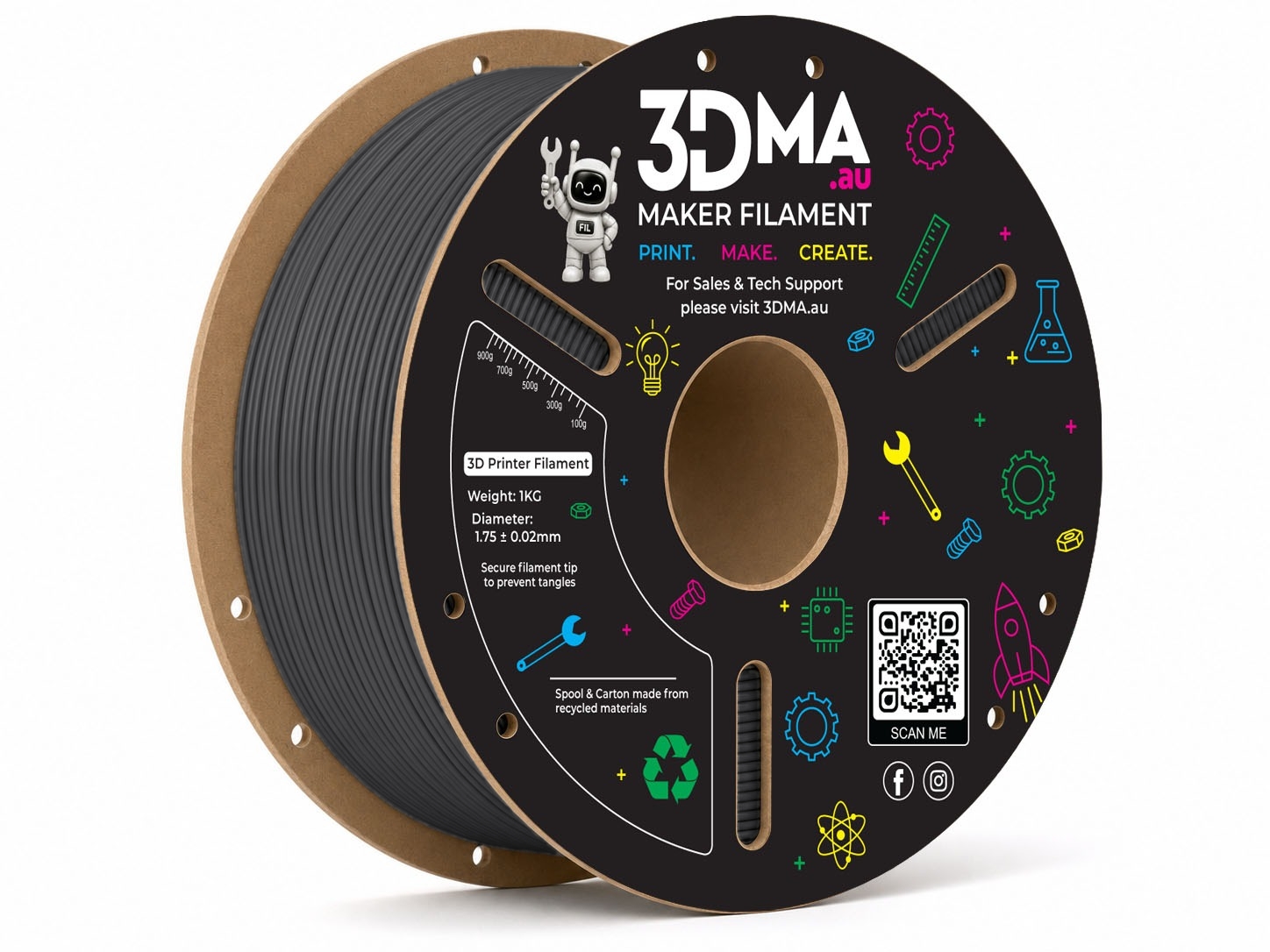
Core ASA is 1.75mm 3D printer filament on a standard 1 kg spool, so it fits any FDM printer that takes 1.75 mm — but the printer has to suit the material as well as the filament. You need an enclosure, a bed that reaches 100 °C and a hotend rated to 270 °C. A standard brass nozzle is fine; unfilled ASA carries nothing abrasive. The spool label states a diameter tolerance of ±0.02 mm, and the filament tip is secured before packing so the spool does not tangle mid-print.
- Bambu Lab X1 & P1 series
- Prusa MK4 with enclosure
- Creality K-series
- Qidi
- Any enclosed 1.75 mm FDM printer
Storage, drying and shelf life
ASA absorbs moisture slowly, but a wet spool prints badly in a way that matters here: bubbling at the nozzle, a rough surface, and weak layer bonding on a part that was chosen precisely because it has to last outside.
Every spool ships sealed with desiccant. Keep it that way between prints and drying will not come up. If a spool has been open through a humid season, the manufacturer’s figure is 80 ± 5 °C for 8 hours in a dryer or blast oven, with storage below 20% relative humidity — the highest drying temperature in the range, and beyond what several popular filament dryers can reach. The storage and drying guide covers which ones can.
Technical specifications
Preparation Before Printing
- Drying settings (blast drying oven)
- 80 ± 5 °C for 8h
- Printing & storage humidity
- ≤ 20% RH (Sealed with Desiccant)
Recommended Printing Settings
- Nozzle temperature
- 240 - 270 °C
- Bed temperature (with glue)
- 90 - 100 °C
- Printing speed
- < 220 mm/s
Physical Properties
- Density
- 1.09 g/cm³
- Melt index
- 14.1 ± 1.2 g/10 min
- Melting temperature
- 214 °C
- Vicat softening temperature
- 102 °C
- Heat deflection temperature
- 99 °C
Mechanical Properties
- Tensile strength
- 35 ± 2 MPa
- Elongation at break
- 10.6% ± 0.9 %
- Bending strength
- 65 ± 4 MPa
- Bending modulus
- 2349 ± 102 MPa
- Impact strength
- 65.5 ± 3.7 kJ/m²
Manufacturer figures for ASA, from PETG / TPU / ABS / ASA Parameters. Test values are measured on standard samples and are for design comparison — real-world results depend on your printer, settings and model.
Common questions about Core ASA
What is the difference between ABS and ASA?
One monomer. ASA replaces the butadiene in ABS with an acrylate, and that single change is what gives it UV resistance — butadiene is the part that breaks down in sunlight. Everything else is close: similar strength, similar printing behaviour, similar hand-finishing. ASA’s published heat deflection temperature of 99 °C is higher than this ABS’s 85 °C, and its impact strength of 65.5 kJ/m² is substantially better.
Is ASA really worth it over PETG for outdoor parts?
If the part sees direct sun, yes. PETG is fine in the shade and much easier to print, but it has no meaningful UV resistance — a PETG part on a north-facing wall will chalk and go brittle over a season or two. ASA is the only material in the range formulated to stop that happening.
Why is ASA difficult to print?
Warping. ASA shrinks as it cools, and any temperature difference across the part pulls it off the bed or splits it along a layer line. The fixes are all about heat management rather than slicer settings: a 100 °C bed, adhesive, a brim, an enclosure that stays shut, and part cooling off. Get those right and it is reliable; get one wrong and you will know within an hour.
Does ASA need an enclosure?
Yes, for anything beyond a very small part. It also needs ventilation, because like ABS it produces a styrene smell while printing.
Can ASA be painted or finished?
Readily. It sands, drills, taps and glues like ABS, takes primer and paint well, and responds to acetone vapour smoothing the same way — which is unusual for a material chosen mainly for durability.
How much can I print from a 1 kg spool?
At ASA’s density of 1.09 g/cm³, a 1 kg spool of 1.75 mm filament holds roughly 380 metres — around 50 metres more than the same weight of PLA, because ASA is one of the lighter polymers in the range.
Will ASA survive an Australian summer?
That is what it is for. Its heat deflection temperature of 99 °C is above anything a parked car interior reaches, and its UV resistance is the reason it is used for car mirror caps and outdoor enclosures in the first place. No other material in this range can make both claims at once.
Reviews
There are no reviews yet.