
Buy more, save more
- 3–5 rolls 3% off
- 6–9 rolls 6% off
- 10–19 rolls 10% off
- 20+ rolls 15% off
Discount is applied automatically in your cart.
ABS-CF
$26.95
1.75 mm diameter · 1 kg net filament per spool
ABS-CF is the range’s serious engineering composite: ABS heat resistance and toughness, stiffened with carbon fibre and printed with far less of the warp that makes plain ABS difficult.
Printing & drying
- Material
- ABS composite
- Diameter
- 1.75 mm
- Spool
- 1 kg net
- Nozzle
- 250–270°C
- Bed
- 100–110°C
- Printing speed
- 30–120 mm/s
- Part cooling
- Off or minimal
- Enclosure
- Required, with ventilation
- Nozzle type
- Hardened steel, 0.6 mm or larger
These are typical working ranges for orientation. The label on the spool you receive is authoritative for that batch. More detail in the storage and drying guide and the troubleshooting guide.
Shipping
- Packed and dispatched from Sydney, Australia.
- Every spool ships sealed with desiccant.
- Tracking is provided on every order.
- Buying more than a few spools? Bulk Orders gets you a quote and a supply plan.
Current delivery timeframes are on the Shipping & Returns page.
Returns & warranty
- Backed by the Australian Consumer Law.
- Spool faults are a product fault, not a settings problem. Contact us with your order number and photos.
- Not sure whether it is the spool or the printer? The five-minute triage tells you which half is at fault.
Full terms on the Shipping & Returns page.
Material details
ABS-CF is the range’s serious engineering composite. Carbon fibre in an ABS matrix gives it a Young’s modulus of 4606 ± 192 MPa and a bending modulus of 4365 ± 154 MPa — by a distance the stiffest material in the catalogue — while ABS carries a heat deflection temperature of 90 °C underneath. It is also the most demanding thing here to print, and it is the only product whose data sheet reports strength along the Z axis as well as across the layers.
What ABS-CF is good for
This is the material for parts that have to be rigid and hot at the same time: brackets in an engine bay, tooling that sits next to something warm, fixtures that must not deflect. The fibre also cuts ABS’s notorious shrinkage, which makes large parts substantially more achievable than they are in plain ABS.
How ABS-CF prints
The data sheet is more specific than the rest of the range, and the numbers are tighter. The nozzle runs at 250–270 °C, the build plate at 100–110 °C, and printing speed sits at 30–120 mm/s — a fraction of what the unfilled materials allow. Cooling fan speed is specified at 0–20%, the recommended build surface is PEI or a PVP glue coating, and the recommended support material is HIPS.
Retraction is specified at 1–3 mm and 1800–3600 mm/min, and raft separation at 0.18–0.2 mm if you use one. Everything else follows ABS practice: enclosure shut for the whole print, adhesive on the plate, and no draughts. A hardened nozzle is mandatory because of the fibre.
What ABS-CF will not do
Read this before you buy it for the wrong job
This is a brittle material. Elongation at break is 1.48 ± 0.11% across the layers and 1.81 ± 0.16% along Z — roughly a seventh of plain PLA — and Charpy impact strength is 8.12 ± 0.78 kJ/m², the lowest figure published for anything in this range. ABS-CF resists bending extremely well and then fails without warning. It is not a material for parts that get dropped.
The sheet also publishes strength along the Z axis, and the gap is worth knowing: 47.86 ± 2.32 MPa tensile across the layers against 28.21 ± 0.35 MPa through them. Orient the part so load runs along the layers, not across them. And like all ABS, it produces a styrene smell and needs ventilation — and it has no UV resistance.
If any of those apply, the range goes elsewhere:
- PETG-CF — stiff and tough
- ASA — outdoor & 99 °C
- PETG-GF — non-conductive fibre
- Ultra ABS — unfilled, less brittle
The Materials Guide compares the composites side by side with the published numbers.
Finish and colour
ABS-CF comes in one finish: matte black with the fine granular texture the fibre gives it. Layer lines effectively disappear, and because ABS sands and machines cleanly, a part can be finished by hand afterwards in a way most composites resist.
1 colours in this material
Printer compatibility
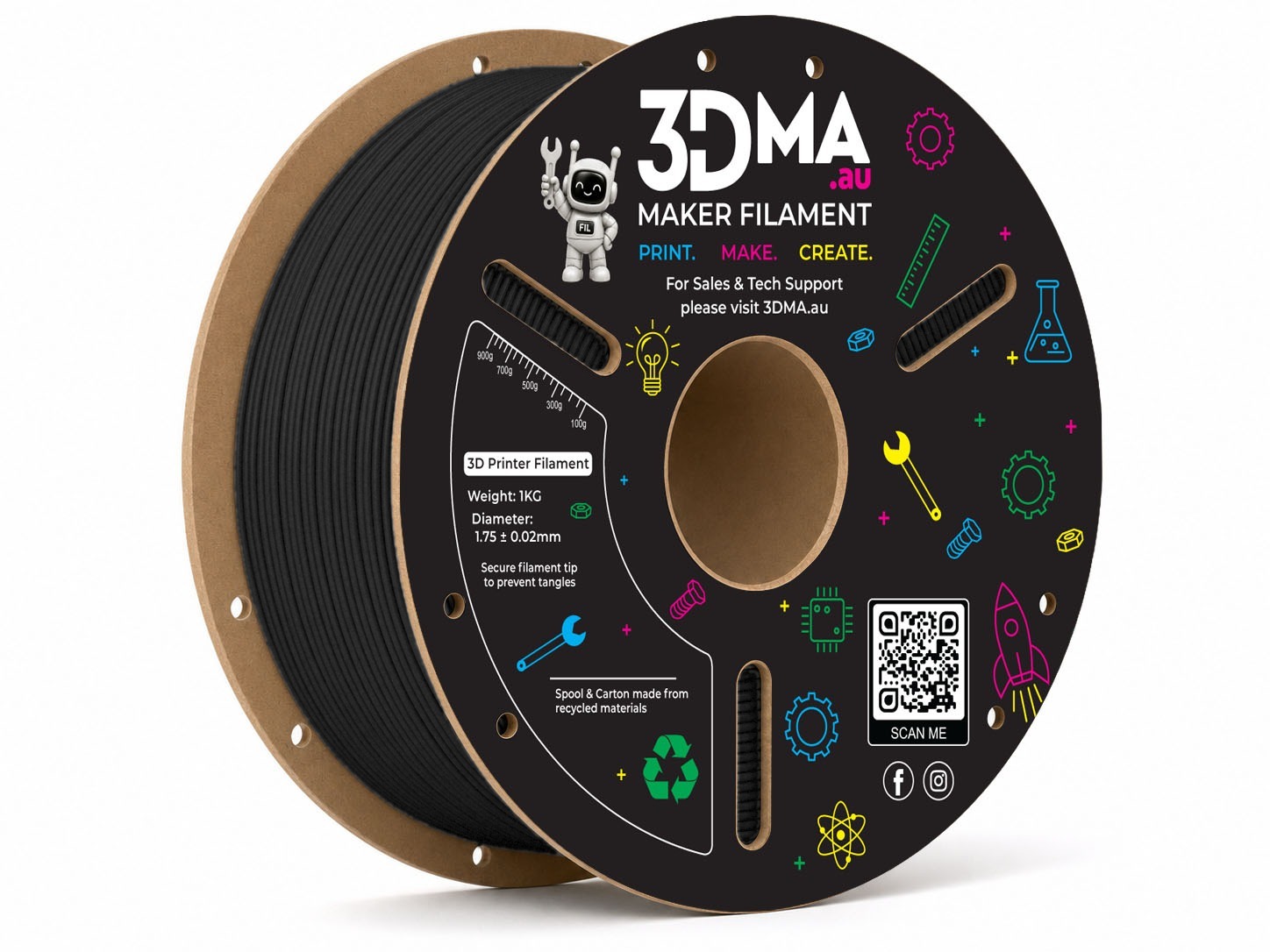
ABS-CF is 1.75mm 3D printer filament on a standard 1 kg spool holding 330 metres, with a stated diameter tolerance of ±0.02 mm. The printer has to suit the material as much as the filament: an enclosure, a build plate that reaches 110 °C, a hotend rated to 270 °C, and a hardened steel nozzle between 0.4 and 1.0 mm. The filament tip is secured before packing so the spool does not tangle mid-print.
- Bambu Lab X1 & P1 series
- Prusa MK4 with enclosure
- Creality K-series
- Qidi
- Enclosed printer + hardened nozzle
Storage and shelf life
The ABS-CF data sheet does not publish a drying schedule, so we are not going to invent one. What is true of every filled filament applies here: the fibre gives moisture somewhere to sit, and a damp spool prints a part that looks acceptable and delaminates under load — which on a material bought for structural work is the failure you can least afford.
Every spool ships sealed with desiccant. Keep it that way between prints, store it below 20% relative humidity as with the rest of the range, and the question will not arise. The storage and drying guide covers sensible practice, and we will publish a drying figure here as soon as the supplier provides one.
Technical specifications
Spool & Filament
- Diameter
- 1.75 mm
- Net filament weight
- 1 kg
- Filament length
- 330 m
- Diameter tolerance
- ±0.02 mm
Recommended Printing Settings
- Nozzle temperature
- 250 – 270 °C
- Recommended nozzle diameter
- 0.4 – 1.0 mm
- Build surface
- PEI or coating with PVP glue
- Build plate temperature
- 100 – 110 °C
- Raft separation distance
- 0.18 – 0.2 mm
- Cooling fan speed
- 0% – 20%
- Printing speed
- 30 – 120 mm/s
- Retraction distance
- 1 – 3 mm
- Retraction speed
- 1800 – 3600 mm/min
- Recommended support material
- HIPS
Physical Properties
- Density
- 1.09 g/cm³ ISO 1183
- Melt index
- 5.5 g/10 min 250 °C, 2.16 kg
- Heat deflection temperature
- 83 °C ISO 75 Method A, 1.80 MPa
- Heat deflection temperature
- 90 °C ISO 75 Method B, 0.45 MPa
Mechanical Properties
- Tensile strength (X-Y)
- 47.86 ± 2.32 MPa ISO 527
- Tensile strength (Z)
- 28.21 ± 0.35 MPa ISO 527
- Young’s modulus (X-Y)
- 4606.28 ± 192.38 MPa ISO 527
- Young’s modulus (Z)
- 2713.50 ± 88.38 MPa ISO 527
- Elongation at break (X-Y)
- 1.48 ± 0.11 % ISO 527
- Elongation at break (Z)
- 1.81 ± 0.16 % ISO 527
- Bending strength (X-Y)
- 80.21 ± 0.55 MPa ISO 178
- Bending modulus (X-Y)
- 4365.29 ± 153.79 MPa ISO 178
- Charpy impact strength (X-Y)
- 8.12 ± 0.78 kJ/m² ISO 179
Manufacturer figures for ABS-CF, from ABS-CF Technical Data Sheet V1.0. Test values are measured on standard samples and are for design comparison — real-world results depend on your printer, settings and model.
Common questions about ABS-CF
Is ABS-CF the strongest filament in the range?
The stiffest, comfortably. Its Young’s modulus of 4606 MPa and bending modulus of 4365 MPa are well clear of everything else here. But strength has more than one meaning: with 1.48% elongation at break and 8.12 kJ/m² Charpy impact strength, it is also the most brittle material in the catalogue. Rigid is not the same as unbreakable.
Why does the data sheet list two tensile strengths?
Because printed parts are not the same strength in every direction. Across the layers, in the X–Y plane, ABS-CF tests at 47.86 MPa. Through the layers, along Z, it tests at 28.21 MPa — about 60% of the figure. Every printed part behaves this way; ABS-CF is simply the one whose sheet tells you by how much. Orient the part so the load runs along the layers.
Do I need an enclosure?
Yes, and ventilation with it. ABS-CF wants a 100–110 °C plate and a stable warm chamber, and like all ABS it produces a styrene smell while printing. The fibre reduces warping compared with plain ABS but does not remove the need for an enclosure.
What nozzle do I need?
Hardened steel, between 0.4 and 1.0 mm per the data sheet. Carbon fibre wears brass out of round within a few spools. In practice 0.6 mm is the sensible default — wide enough that a fibre bundle will not bridge the orifice, fine enough for most engineering detail.
Why is the print speed so much lower than everything else?
The sheet specifies 30–120 mm/s, against up to 600 for the unfilled High Flow materials. Fibre-loaded melt does not flow freely, and forcing it produces under-extrusion and weak layer bonding on a part bought precisely for its mechanical properties. Slow is part of the specification, not a limitation to work around.
How much can I print from a 1 kg spool?
The data sheet states 330 metres for a 1 kg spool at 1.75 mm. At a density of 1.09 g/cm³, ABS-CF is also one of the lighter materials in the range, so the same part weighs less printed here than in PETG or PLA.
Can ABS-CF parts be used outdoors?
Only in the shade. It handles heat well but has no UV resistance — in direct sun it yellows and embrittles like any ABS. Core ASA is the material for sun exposure, with a heat deflection temperature of 99 °C that beats this one.
Reviews
There are no reviews yet.