
Buy more, save more
- 3–5 rolls 3% off
- 6–9 rolls 6% off
- 10–19 rolls 10% off
- 20+ rolls 15% off
Discount is applied automatically in your cart.
Tri-Silk PLA
$23.95
1.75 mm diameter · 1 kg net filament per spool
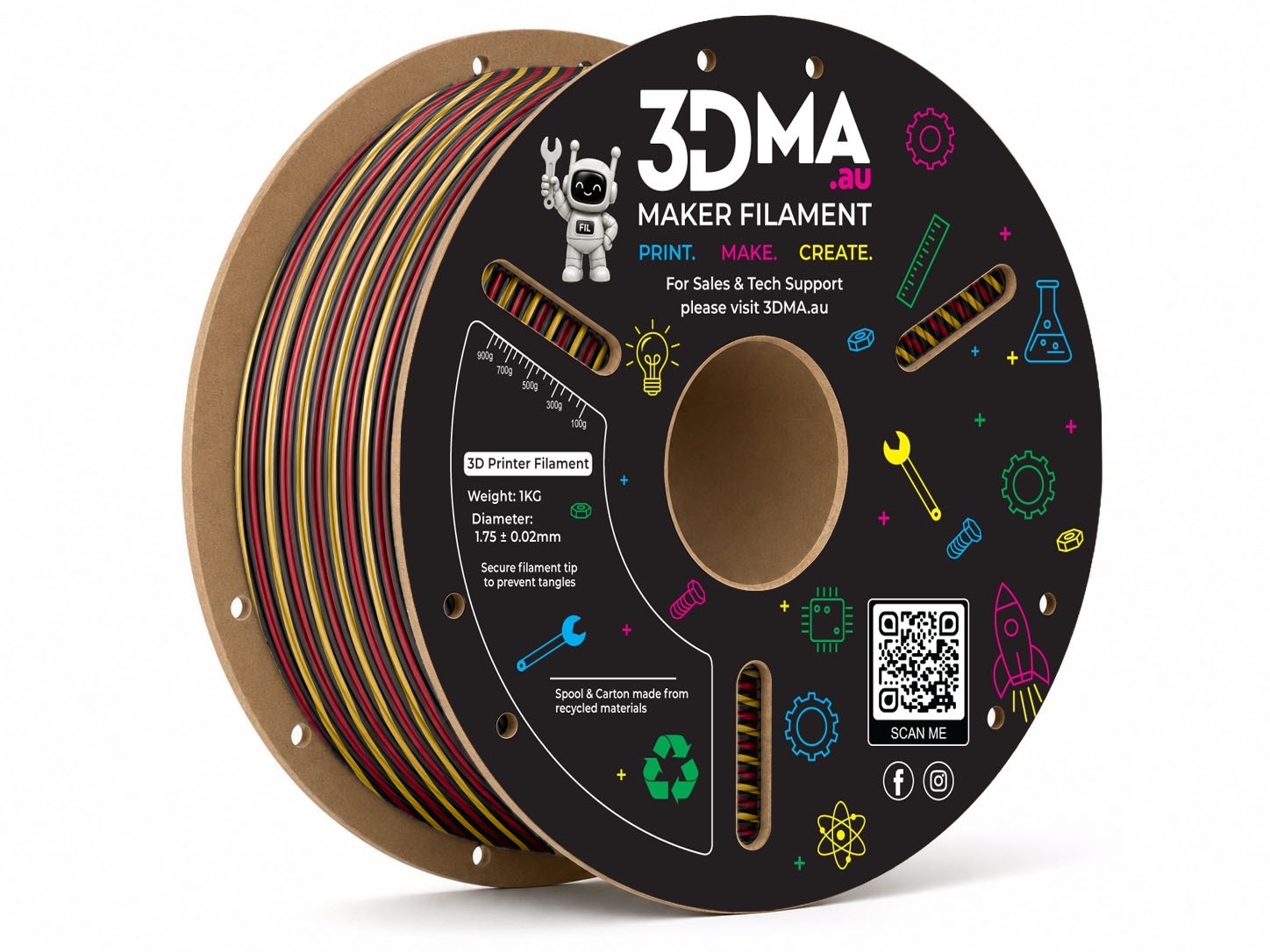
Tri-Silk PLA runs three silk colours through a single strand for prints that blend and shift between all three as the geometry turns — the maximalist option in the silk family.
Printing & drying
- Material
- PLA
- Diameter
- 1.75 mm
- Spool
- 1 kg net
- Nozzle
- 190–230°C
- Bed
- 35–65°C
- Printing speed
- < 220 mm/s
- Part cooling
- High
- Enclosure
- Not required
- Nozzle type
- Standard brass
- Drying
- 50 ± 5°C for 8h
These are typical working ranges for orientation. The label on the spool you receive is authoritative for that batch. More detail in the storage and drying guide and the troubleshooting guide.
Shipping
- Packed and dispatched from Sydney, Australia.
- Every spool ships sealed with desiccant.
- Tracking is provided on every order.
- Buying more than a few spools? Bulk Orders gets you a quote and a supply plan.
Current delivery timeframes are on the Shipping & Returns page.
Returns & warranty
- Backed by the Australian Consumer Law.
- Spool faults are a product fault, not a settings problem. Contact us with your order number and photos.
- Not sure whether it is the spool or the printer? The five-minute triage tells you which half is at fault.
Full terms on the Shipping & Returns page.
Material details
Tri-Silk PLA adds a third colour to the strand, and the extra colour changes the character of the effect entirely. Where two colours shade from one to the other, three produce unexpected blends where they meet — on a large curved model the result approaches iridescence, and the same print looks different from every seat in the room.
What Tri-Silk PLA is good for
This is the show-off material of the range, and it rewards being treated that way. Three colours need room to perform: on a small print they crowd each other and read as noise, but on a large dragon or a statement vase they resolve into transitions you could not plan if you tried.
How Tri-Silk PLA prints
The manufacturer’s published window is a nozzle at 190–230 °C and a bed at 35–65 °C with adhesive, at speeds up to 220 mm/s — the silk PLA envelope. Handle it as silk first: warm nozzle, reduced part cooling, slow outer wall. The gloss is what makes the colour transitions read as blends rather than bands.
Model orientation matters more here than on Dual-Silk, because there are three colours competing for the same surfaces. Rotating the part in the slicer meaningfully changes which colour lands where, and on a hero print it is worth running a small test piece first.
What Tri-Silk PLA will not do
Read this before you buy it for the wrong job
It carries silk PLA’s mechanical numbers — a tensile strength of 26 ± 3 MPa and an impact strength of 25.5 ± 2.2 kJ/m², the lowest published figures in the catalogue, with decorative-grade layer adhesion. Nothing structural should be printed in it.
It also does not suit small prints. Three colours on a 40 mm figurine sit too close together to resolve, and the result reads as muddled rather than iridescent. And at 54 °C heat deflection it shares the lowest heat tolerance in the PLA range, with no UV resistance.
If you want the effect at a smaller scale or in something tougher, the range goes elsewhere:
- Dual-Silk — two colours, smaller prints
- Rainbow-Silk — shifts up the print
- Silk PLA — single colour, same gloss
- Nebula PLA — depth without fragility
The Materials Guide sets the decorative PLAs side by side with the published numbers.
Every combination, one material
Both Tri-Silk combinations are the same polymer with the same settings — only the trio of colours changes. A profile tuned for one carries straight across to the other. Each combination is its own tile in the store, so what you click is what arrives.
2 colours in this material
Printer compatibility
Tri-Silk PLA is 1.75mm 3D printer filament on a standard 1 kg spool, so it runs on any FDM printer that takes 1.75 mm — Bambu Lab, Prusa, Creality, Elegoo, Anycubic and the rest. Standard brass nozzle, no hardware change, and no multi-material unit required: all three colours are in the strand. The spool label states a diameter tolerance of ±0.02 mm, and the filament tip is secured before packing so the spool does not tangle mid-print.
- Bambu Lab
- Prusa
- Creality
- Elegoo
- Anycubic
- Sovol
- Any 1.75 mm FDM printer
Storage, drying and shelf life
Moisture costs you the gloss, and without the gloss the three colours read as flat bands instead of blends. A damp spool produces a dull, patchy surface that looks like a settings problem rather than a storage one.
Every spool ships sealed with desiccant. Keep it that way between prints and drying will not come up. If a spool has been open through a humid season, the manufacturer’s figure is 50 ± 5 °C for 8 hours in a dryer or blast oven, with storage below 20% relative humidity. The storage and drying guide covers what that looks like in practice.
Technical specifications
Preparation Before Printing
- Drying settings (blast drying oven)
- 50 ± 5 °C for 8h
- Printing & storage humidity
- ≤ 20% RH (Sealed with Desiccant)
Recommended Printing Settings
- Nozzle temperature
- 190 - 230 °C
- Bed temperature (with glue)
- 35 - 65 °C
- Printing speed
- < 220 mm/s
Physical Properties
- Density
- 1.25 g/cm³
- Melt index
- 28.7 ± 2.1 g/10 min
- Melting temperature
- 164 °C
- Vicat softening temperature
- 58 °C
- Heat deflection temperature
- 54 °C
Mechanical Properties
- Tensile strength
- 26 ± 3 MPa
- Elongation at break
- 9.7% ± 2.3%
- Bending strength
- 79 ± 2 MPa
- Bending modulus
- 2816 ± 136 MPa
- Impact strength
- 25.5 ± 2.2 kJ/m²
Manufacturer figures for PLA Silk, from PLA Series Parameters. Test values are measured on standard samples and are for design comparison — real-world results depend on your printer, settings and model.
Common questions about Tri-Silk PLA
Do I need a multi-material printer?
No. All three colours run down the single strand. One nozzle, one spool, no AMS, no tool changer and no purge waste.
Why does my small print look muddled?
Three colours need surface area. On a small model they change faster than the eye can resolve into transitions, so the piece reads as mottled. Print it larger, or use Dual-Silk, which works at smaller scales.
Can I control the colour placement?
Only through orientation. Rotating the model in the slicer changes which faces catch which colour, and on this material the difference is substantial. For a long print, test the orientation on a small sample first.
Is Tri-Silk stronger than regular Silk PLA?
No — the published figures are identical. Tensile strength of 26 MPa, impact strength of 25.5 kJ/m², heat deflection at 54 °C. The extra colour changes the appearance, not the polymer.
How do I get the best result?
Print big, print curved, print slow, print warm. Large twisting geometry gives the colours room to develop; a warm nozzle and reduced cooling give the surface the gloss that turns bands into blends.
How much can I print from a 1 kg spool?
At a density of 1.25 g/cm³, a 1 kg spool of 1.75 mm filament holds roughly 335 metres. Hero prints are large but usually hollow or vase-mode, so a spool goes further than it looks.
Will two prints from the same spool match?
Closely, but not exactly — and on a display piece that is a feature rather than a fault. The colours sit in fixed positions in the strand, so the pattern depends on the model and its orientation rather than where you are on the spool.
Reviews
There are no reviews yet.