
Buy more, save more
- 3–5 rolls 3% off
- 6–9 rolls 6% off
- 10–19 rolls 10% off
- 20+ rolls 15% off
Discount is applied automatically in your cart.
Nebula PLA
$22.95
1.75 mm diameter · 1 kg net filament per spool
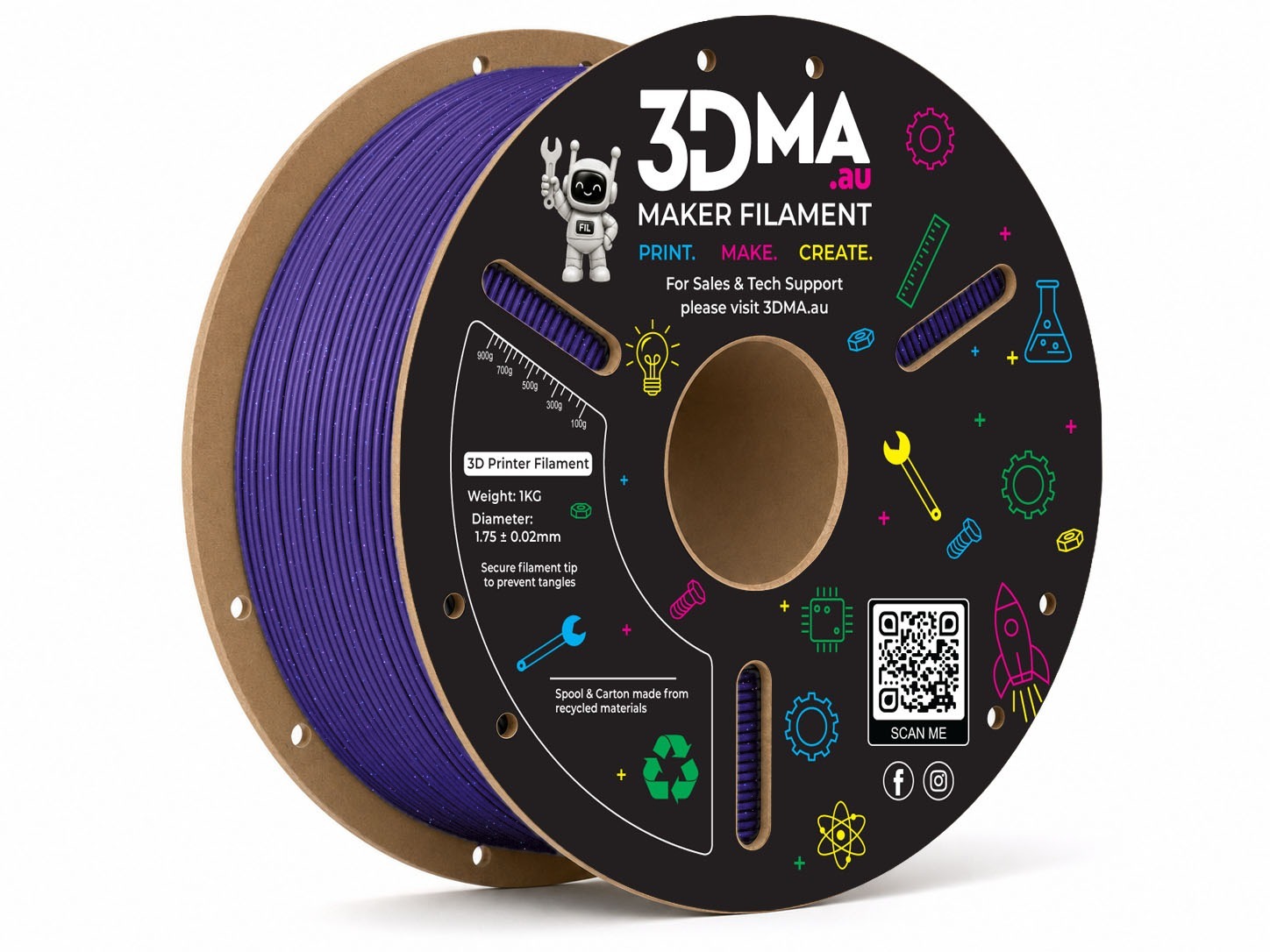
Nebula PLA packs fine sparkle into deep, saturated colour for prints with the depth of a night sky. Where standard PLA is flat colour, Nebula shimmers — planets, dragons, vases and sci-fi props all become display pieces.
Printing & drying
- Material
- PLA
- Diameter
- 1.75 mm
- Spool
- 1 kg net
- Nozzle
- 190–230°C
- Bed
- 35–65°C
- Printing speed
- < 200 mm/s
- Part cooling
- High
- Enclosure
- Not required
- Nozzle type
- Standard brass
- Drying
- 50 ± 5°C for 8h
These are typical working ranges for orientation. The label on the spool you receive is authoritative for that batch. More detail in the storage and drying guide and the troubleshooting guide.
Shipping
- Packed and dispatched from Sydney, Australia.
- Every spool ships sealed with desiccant.
- Tracking is provided on every order.
- Buying more than a few spools? Bulk Orders gets you a quote and a supply plan.
Current delivery timeframes are on the Shipping & Returns page.
Returns & warranty
- Backed by the Australian Consumer Law.
- Spool faults are a product fault, not a settings problem. Contact us with your order number and photos.
- Not sure whether it is the spool or the printer? The five-minute triage tells you which half is at fault.
Full terms on the Shipping & Returns page.
Material details
Nebula PLA suspends fine micro-glitter inside deep, saturated colour, and the result reads closer to metallic car paint than to plastic. Light picks out individual sparkle points at different depths in the wall, which gives the surface a dimensional, galaxy-like quality that a flat pigment cannot produce. It also happens to be one of the tougher decorative PLAs in the range.
What Nebula PLA is good for
The sparkle does two jobs. The first is obvious — it looks expensive. The second is that it breaks up layer lines the way matte filament does, so a print at a chunky layer height looks cleaner than its settings deserve. Fast prints come off the plate looking like considered ones.
How Nebula PLA prints
The manufacturer’s published window is a nozzle at 190–230 °C and a bed at 35–65 °C with adhesive, at speeds up to 200 mm/s. That speed ceiling is lower than Core PLA’s 300, which is typical of particle-filled filaments — the glitter thickens the melt slightly and rushing it costs surface quality, which is the whole reason you bought this.
The glitter here is fine, and a 0.4 mm brass nozzle handles it without complaint. Like any particle-filled filament it is mildly abrasive over the long run, so if this is going to be a staple rather than an occasional spool, a hardened steel nozzle will outlast a brass one by a wide margin.
What Nebula PLA will not do
Read this before you buy it for the wrong job
It is still PLA where it counts against the environment: heat deflection at 56 °C, Vicat softening at 62, and no meaningful UV resistance. A display piece on a sunny windowsill will fade and eventually distort, and a part in a parked car will sag.
The sparkle is also a surface effect that rewards the right geometry. On small, flat, angular models there is not enough surface for the light to play across, and the material reads as a slightly speckled solid colour instead. Save it for pieces with curves and size.
If you need the finish somewhere tougher, the range goes elsewhere:
- Glitter PLA — bolder sparkle
- Silk PLA — gloss instead of sparkle
- Core PLA — tougher, plain
- ASA — outdoor display pieces
The Materials Guide sets the decorative PLAs side by side with the published numbers.
Every colour, one material
Both Nebula colours are the same polymer with the same settings — only the pigment and sparkle change. Each colour is its own tile in the store, so what you click is what arrives.
2 colours in this material
Printer compatibility
Nebula PLA is 1.75mm 3D printer filament on a standard 1 kg spool, so it runs on any FDM printer that takes 1.75 mm — Bambu Lab, Prusa, Creality, Elegoo, Anycubic and the rest. A standard 0.4 mm brass nozzle is fine for occasional use; hardened steel is the sensible choice if you print it often. The spool label states a diameter tolerance of ±0.02 mm, and the filament tip is secured before packing so the spool does not tangle mid-print.
- Bambu Lab
- Prusa
- Creality
- Elegoo
- Anycubic
- Sovol
- Any 1.75 mm FDM printer
Storage, drying and shelf life
Moisture costs you the finish before it costs you anything else. Wet filament prints a rough, furry surface, and a rough surface scatters light at random instead of letting the glitter catch it — so a damp spool produces a print that looks dull rather than obviously faulty.
Every spool ships sealed with desiccant. Keep it that way between prints and drying will not come up. If a spool has been open through a humid season, the manufacturer’s figure is 50 ± 5 °C for 8 hours in a dryer or blast oven, with storage below 20% relative humidity. The storage and drying guide covers what that looks like in practice.
Technical specifications
Preparation Before Printing
- Drying settings (blast drying oven)
- 50 ± 5 °C for 8h
- Printing & storage humidity
- ≤ 20% RH (Sealed with Desiccant)
Recommended Printing Settings
- Nozzle temperature
- 190 - 230 °C
- Bed temperature (with glue)
- 35 - 65 °C
- Printing speed
- < 200 mm/s
Physical Properties
- Density
- 1.21 g/cm³
- Melt index
- 11.3 ± 2.6 g/10 min
- Melting temperature
- 162 °C
- Vicat softening temperature
- 62 °C
- Heat deflection temperature
- 56 °C
Mechanical Properties
- Tensile strength
- 38 ± 3 MPa
- Elongation at break
- 8.7% ± 1.2%
- Bending strength
- 75 ± 2 MPa
- Bending modulus
- 2719 ± 179 MPa
- Impact strength
- 56.3 ± 3.5 kJ/m²
Manufacturer figures for PLA Chameleon, from PLA Series Parameters. Test values are measured on standard samples and are for design comparison — real-world results depend on your printer, settings and model.
Common questions about Nebula PLA
Does the glitter come off on my hands?
No. The particles are bonded into the polymer during manufacture, not dusted onto it. The sparkle is inside the plastic, so it cannot shed, rub off or leave a mess on the bench.
Do I need a hardened nozzle?
Not for occasional printing — the glitter here is fine and a 0.4 mm brass nozzle handles it. If Nebula becomes a regular material for you, fit hardened steel: every particle-filled filament wears brass over time.
Does it hide layer lines?
Yes, and noticeably. The sparkle interrupts the eye the same way a matte surface does, so prints at 0.2 or even 0.28 mm layers look cleaner than the settings would suggest. It is one of the more forgiving decorative filaments for a fast print.
Is Nebula PLA strong?
For a decorative PLA, unusually so. Its impact strength of 56.3 kJ/m² is more than twice Silk PLA’s and well ahead of Matte PLA’s, and its tensile strength of 38 MPa matches Core PLA’s. Handled pieces like dice towers survive it comfortably.
What settings give the best sparkle?
Keep within the published 200 mm/s ceiling and let the outer wall print slowly. Beyond that, geometry matters more than settings — curves and larger surfaces let the light move across the sparkle as you turn the piece.
How much can I print from a 1 kg spool?
At a density of 1.21 g/cm³ — the lowest of any PLA in this range — a 1 kg spool of 1.75 mm filament holds roughly 345 metres, a little more than Core PLA for the same money’s worth of material.
Can I paint over it?
You can, but it defeats the purpose. The depth in the surface comes from light reaching particles below it, and paint blocks that. If a piece needs paint, print it in Matte PLA, which is a far better base.
Reviews
There are no reviews yet.