
Buy more, save more
- 3–5 rolls 3% off
- 6–9 rolls 6% off
- 10–19 rolls 10% off
- 20+ rolls 15% off
Discount is applied automatically in your cart.
Luminous PLA
$24.95
1.75 mm diameter · 1 kg net filament per spool
Luminous PLA charges up under any light and glows in the dark. It turns switch surrounds, kids’ prints, props and markers into things that keep working after lights out — rechargeable indefinitely.
Printing & drying
- Material
- PLA
- Diameter
- 1.75 mm
- Spool
- 1 kg net
- Nozzle
- 190–230°C
- Bed
- 35–65°C
- Printing speed
- < 250 mm/s
- Part cooling
- High
- Enclosure
- Not required
- Nozzle type
- Standard brass
- Drying
- 55 ± 5°C
These are typical working ranges for orientation. The label on the spool you receive is authoritative for that batch. More detail in the storage and drying guide and the troubleshooting guide.
Shipping
- Packed and dispatched from Sydney, Australia.
- Every spool ships sealed with desiccant.
- Tracking is provided on every order.
- Buying more than a few spools? Bulk Orders gets you a quote and a supply plan.
Current delivery timeframes are on the Shipping & Returns page.
Returns & warranty
- Backed by the Australian Consumer Law.
- Spool faults are a product fault, not a settings problem. Contact us with your order number and photos.
- Not sure whether it is the spool or the printer? The five-minute triage tells you which half is at fault.
Full terms on the Shipping & Returns page.
Material details
Luminous PLA stores light and gives it back. Phosphorescent particles blended through the filament charge under daylight or a lamp in a few minutes, glow brightest in the first minutes after the lights go out, then fade gently over the hours that follow — and they recharge indefinitely. There is no battery, no electronics, and no limit on how many times you can do it.
What Luminous PLA is good for
The obvious use is novelty, and it is very good at that. The less obvious one is practical: anything you need to find in the dark is better printed in this than in a colour you have to hunt for with a torch.
How Luminous PLA prints
The manufacturer’s published window is a nozzle at 190–230 °C and a bed at 35–65 °C with adhesive, at speeds up to 250 mm/s — standard PLA territory, with no enclosure and high part cooling. The one thing that genuinely changes the result is wall thickness: more material means more pigment in the light path, so three or more perimeters glow noticeably brighter and longer than two.
Glow pigment is a hard mineral rather than a dye, so like every filled filament it wears a brass nozzle faster than unfilled PLA does. A hardened steel nozzle is cheap insurance if you plan to print more than the odd spool — and it is the same nozzle the composites in this range need.
What Luminous PLA will not do
Read this before you buy it for the wrong job
The glow fades over hours, not all night. Phosphorescence is brightest in the first few minutes and decays from there — expect a useful glow for a couple of hours in a genuinely dark room, and much less in one with any ambient light. It also needs to be charged: a part kept in a drawer glows for nothing.
Its impact strength of 34.9 ± 3.2 kJ/m² is about half Core PLA’s, and its elongation at break of 7.2% is among the lowest of any PLA here, so it is comparatively brittle. And it is still PLA: heat deflection at 56 °C, no UV resistance, so outdoor camping gear will not last a season of Australian sun.
If the part needs to work harder than it needs to glow, the range goes elsewhere:
- Core PLA — tougher, cheaper
- PLA+ — functional prints
- Translucent PLA+ — lit from behind
- PETG — outdoor gear
The Materials Guide sets the PLA family side by side if you are choosing between effect and durability.
Every colour, one material
Both glow colours are the same polymer with the same settings — only the pigment changes. In daylight they read as a pale tint; in the dark they do the work. Each colour is its own tile in the store, so what you click is what arrives.
2 colours in this material
Printer compatibility
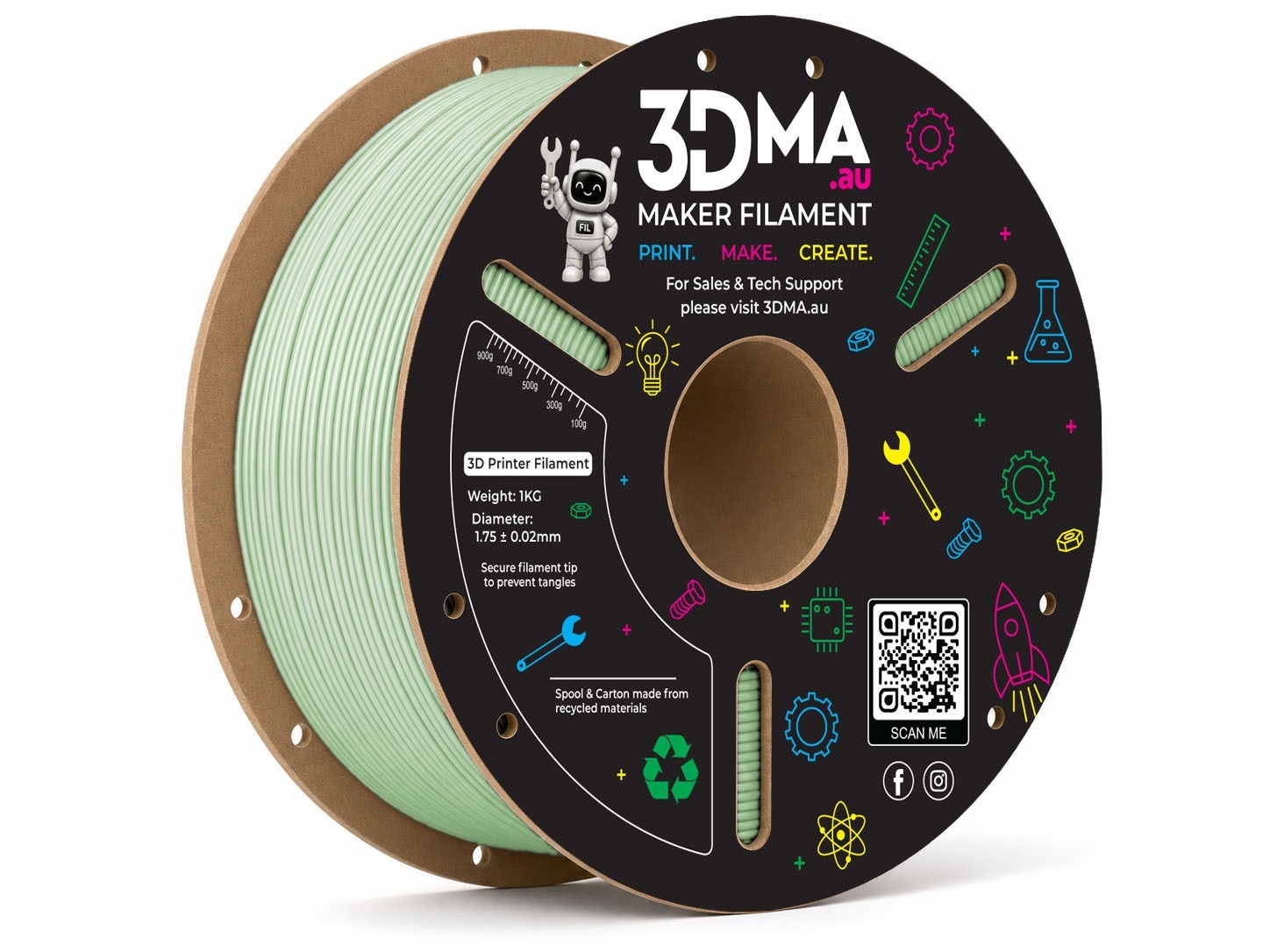
Luminous PLA is 1.75mm 3D printer filament on a standard 1 kg spool, so it runs on any FDM printer that takes 1.75 mm — Bambu Lab, Prusa, Creality, Elegoo, Anycubic and the rest. A hardened steel nozzle is recommended because of the pigment, but nothing else changes. The spool label states a diameter tolerance of ±0.02 mm, and the filament tip is secured before packing so the spool does not tangle mid-print.
- Bambu Lab
- Prusa
- Creality
- Elegoo
- Anycubic
- Sovol
- Hardened nozzle recommended
Storage, drying and shelf life
Luminous PLA absorbs moisture at about the rate plain PLA does, and the symptoms are the same — popping at the nozzle, stringing, and a rough surface that scatters the glow unevenly.
Every spool ships sealed with desiccant. Keep it that way between prints and drying will not come up. If a spool has been open through a humid season, the manufacturer’s figure is 55 ± 5 °C in a dryer or blast oven, with storage below 20% relative humidity. The storage and drying guide covers what that looks like in practice.
Technical specifications
Preparation Before Printing
- Drying settings (blast drying oven)
- 55 ± 5 °C
- Printing & storage humidity
- ≤ 20% RH (Sealed with Desiccant)
Recommended Printing Settings
- Nozzle temperature
- 190 - 230 °C
- Bed temperature (with glue)
- 35 - 65 °C
- Printing speed
- < 250 mm/s
Physical Properties
- Density
- 1.24 g/cm³
- Melt index
- /
- Melting temperature
- 157 °C
- Vicat softening temperature
- 57 °C
- Heat deflection temperature
- 56 °C
Mechanical Properties
- Tensile strength
- 42 ± 2 MPa
- Elongation at break
- 7.2% ± 0.6%
- Bending strength
- 77 ± 2 MPa
- Bending modulus
- 3190 ± 131 MPa
- Impact strength
- 34.9 ± 3.2 kJ/m²
Manufacturer figures for PLA Luminous, from PLA Series Parameters. Test values are measured on standard samples and are for design comparison — real-world results depend on your printer, settings and model.
Common questions about Luminous PLA
How long does the glow last?
Brightest for the first few minutes, then fading gradually over a couple of hours in a properly dark room. It is a decay curve rather than an on-off switch, so what counts as “still glowing” depends on how dark the room is and how well your eyes have adjusted.
How do I charge it?
Any bright light works — daylight through a window, a desk lamp, a phone torch. A few minutes is enough for a full charge. UV charges it fastest, which is why the effect is so dramatic under a blacklight, but it is not required.
How do I make a print glow brighter?
Use more walls. Three or more perimeters put more pigment where the light can reach it and where you can see it, which makes a measurable difference. Thin, single-wall prints glow noticeably more faintly.
Do I need a hardened nozzle?
It is recommended rather than mandatory. The glow pigment is a hard mineral and wears brass faster than unfilled PLA, so if you plan to print more than an occasional spool, a hardened steel nozzle is worth fitting — and it is the same one the composite filaments need.
Is it as strong as normal PLA?
No. Its impact strength of 34.9 kJ/m² is about half Core PLA’s 66.2, and at 7.2% elongation at break it is one of the more brittle PLAs in the range. It is a decorative material — print load-bearing parts in Core PLA or PLA+.
Does the glow wear out?
No. Phosphorescence is a physical process, not a consumable — the pigment can be charged and discharged indefinitely. What will eventually degrade a part left outdoors is UV damage to the PLA around the pigment, not the pigment itself.
How much can I print from a 1 kg spool?
At a density of 1.24 g/cm³, a 1 kg spool of 1.75 mm filament holds roughly 335 metres. Bear in mind that glow prints want extra walls, so a spool covers fewer parts than the metres alone suggest.
Reviews
There are no reviews yet.