
Buy more, save more
- 3–5 rolls 3% off
- 6–9 rolls 6% off
- 10–19 rolls 10% off
- 20+ rolls 15% off
Discount is applied automatically in your cart.
Translucent PLA+
$17.95
1.75 mm diameter · 1 kg net filament per spool
Translucent PLA+ lets light into your prints. From lamp shades and LED diffusers to stained-glass-style models, it produces rich, semi-clear colour that ordinary opaque filament can’t match.
Printing & drying
- Material
- PLA+
- Diameter
- 1.75 mm
- Spool
- 1 kg net
- Nozzle
- 205–230°C
- Bed
- 35–65°C
- Printing speed
- < 150 mm/s
- Part cooling
- High
- Enclosure
- Not required
- Nozzle type
- Standard brass
- Drying
- 50 ± 5°C for 8h
These are typical working ranges for orientation. The label on the spool you receive is authoritative for that batch. More detail in the storage and drying guide and the troubleshooting guide.
Shipping
- Packed and dispatched from Sydney, Australia.
- Every spool ships sealed with desiccant.
- Tracking is provided on every order.
- Buying more than a few spools? Bulk Orders gets you a quote and a supply plan.
Current delivery timeframes are on the Shipping & Returns page.
Returns & warranty
- Backed by the Australian Consumer Law.
- Spool faults are a product fault, not a settings problem. Contact us with your order number and photos.
- Not sure whether it is the spool or the printer? The five-minute triage tells you which half is at fault.
Full terms on the Shipping & Returns page.
Material details
Translucent PLA+ lets light through. It is the material for lamp shades, light diffusers, stained-glass effects and anything where a print is meant to glow rather than sit there — and it is also, on the published numbers, the strongest PLA in the catalogue: 55.4 ± 5 MPa tensile strength and an 85 ± 3 MPa bending strength, both well clear of anything else in the PLA range.
What Translucent PLA+ is good for
Translucency in a printed part is not the same as transparency. Light passes through and diffuses, so the wall glows evenly rather than letting you see through it — which is usually what you actually want from a shade or a diffuser. How much light gets through is a function of wall count and infill, so the same spool gives you anything from a faint tint to a genuine lantern.
How Translucent PLA+ prints
The manufacturer’s published window is a nozzle at 205–230 °C and a bed at 35–65 °C with adhesive, at speeds up to 150 mm/s — the slowest ceiling of any PLA in the range. That is deliberate: clarity depends on the beads fusing into one another without trapping air, and air gaps are what turn a translucent print cloudy.
For the clearest result, slow down further than you think you need to, run the nozzle warm, and ease the part cooling back so each layer welds properly to the one beneath. Fewer, thicker walls beat many thin ones, and vase mode — one continuous wall, no infill — gives the most even light transmission of any approach.
What Translucent PLA+ will not do
Read this before you buy it for the wrong job
This is translucent, not transparent. No FDM print will be optically clear — the layer boundaries and the bead geometry scatter light no matter how well you tune it. If you need to read text through a part, printing is the wrong process.
It is also the most brittle PLA here despite being the strongest in tension: its impact strength of 18.5 ± 3.7 kJ/m² is the lowest of any PLA in the range, less than a third of Core PLA’s. Strong in a steady pull, poor under a sudden knock. And it is still PLA for heat and sun: 55 °C heat deflection, no UV resistance, so a light fitting near a window will eventually suffer on both counts.
If clarity or toughness is what you actually need, the range goes elsewhere:
- Core PLA — far better under impact
- PETG — tough, glossy, moisture-proof
- Luminous PLA — glows without a light
- Silk PLA — gloss without transmission
The Materials Guide sets the PLA family side by side with the published numbers.
Every colour, one material
Every colour of this translucent PLA filament is the same polymer with the same settings — only the tint changes. Because they share a profile, overlapping two colours in a multi-material print produces a predictable blend where they meet. Each colour is its own tile in the store, so what you click is what arrives.
Printer compatibility
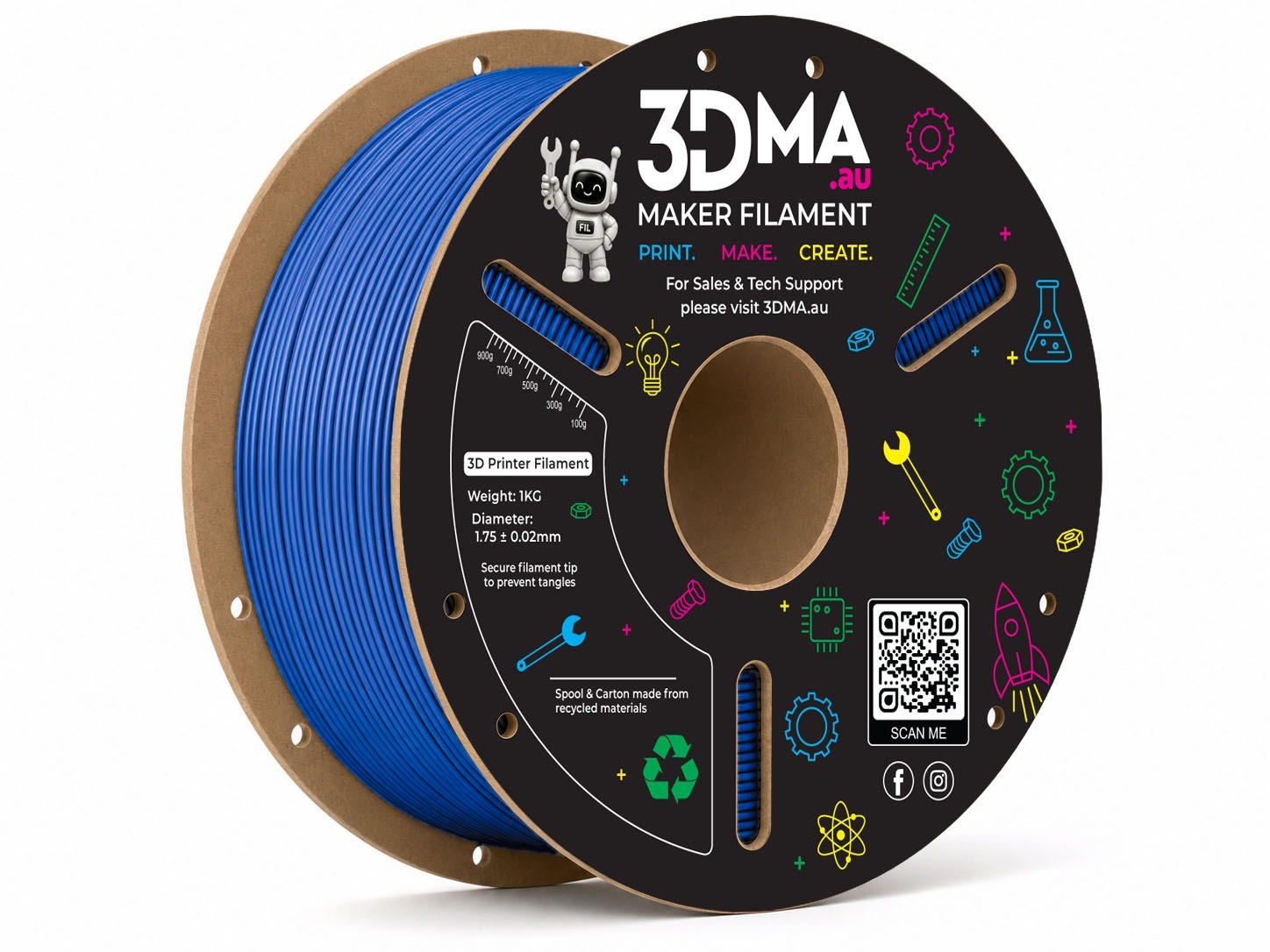
Translucent PLA+ is 1.75mm 3D printer filament on a standard 1 kg spool, so it runs on any FDM printer that takes 1.75 mm — Bambu Lab, Prusa, Creality, Elegoo, Anycubic and the rest. Standard brass nozzle, no hardware change, and it feeds through an AMS or other multi-material unit without trouble. The spool label states a diameter tolerance of ±0.02 mm, and the filament tip is secured before packing so the spool does not tangle mid-print.
- Bambu Lab
- Prusa
- Creality
- Elegoo
- Anycubic
- Sovol
- Any 1.75 mm FDM printer
Storage, drying and shelf life
Moisture is more visible in this material than in any other PLA. Water in the melt boils into micro-bubbles, and micro-bubbles scatter light — so a damp spool prints a part that is cloudy rather than merely rough. If a translucent print comes out milky when it used to be clear, dry the filament before you change a single slicer setting.
Every spool ships sealed with desiccant. Keep it that way between prints and drying will not come up. If a spool has been open through a humid season, the manufacturer’s figure is 50 ± 5 °C for 8 hours in a dryer or blast oven, with storage below 20% relative humidity. The storage and drying guide covers what that looks like in practice.
Technical specifications
Preparation Before Printing
- Drying settings (blast drying oven)
- 50 ± 5 °C for 8h
- Printing & storage humidity
- ≤ 20% RH (Sealed with Desiccant)
Recommended Printing Settings
- Nozzle temperature
- 205 - 230 °C
- Bed temperature (with glue)
- 35 - 65 °C
- Printing speed
- < 150 mm/s
Physical Properties
- Density
- 1.22 g/cm³
- Melt index
- 4.08 ± 1.5 g/10 min
- Melting temperature
- 156 °C
- Vicat softening temperature
- 61 °C
- Heat deflection temperature
- 55 °C
Mechanical Properties
- Tensile strength
- 55.4 ± 5 MPa
- Elongation at break
- 11% ± 3.1%
- Bending strength
- 85 ± 3 MPa
- Bending modulus
- 3000 ± 120 MPa
- Impact strength
- 18.5 ± 3.7 kJ/m²
Manufacturer figures for PLA+Translucent, from PLA Series Parameters. Test values are measured on standard samples and are for design comparison — real-world results depend on your printer, settings and model.
Common questions about Translucent PLA+
Will my prints be see-through?
They will pass light, not an image. A thin wall glows evenly and shows the shape of a light source behind it; you will not read through it. That diffusion is usually the point — it is what makes a shade look like a shade rather than a bare bulb in a box.
How do I make a print more transparent?
Fewer, thicker walls and no infill. Vase mode gives the most light transmission because there are no internal boundaries to scatter at. Beyond that: print slowly, run the nozzle warm, and reduce part cooling so the layers fuse rather than stack. A dry spool matters more here than anywhere else.
Is Translucent PLA+ strong?
In one direction, remarkably. Its tensile strength of 55.4 MPa and bending strength of 85 MPa are the highest published figures of any PLA in this range. But its impact strength of 18.5 kJ/m² is the lowest — it resists a steady pull and shatters under a sudden knock.
Can I use it for a light fitting?
For the shade, yes, with an LED. Keep it away from anything that gets genuinely hot: PLA softens from around 55 °C, so an incandescent or halogen source is not appropriate. LEDs run cool enough that this is a non-issue in practice.
Why is it slower to print than other PLA?
Because clarity depends on the beads welding together without trapping air, and that takes time in the melt. The published ceiling is 150 mm/s against Core PLA’s 300. Printing faster does not fail — it just comes out cloudier.
How much can I print from a 1 kg spool?
At a density of 1.22 g/cm³, a 1 kg spool of 1.75 mm filament holds roughly 340 metres. Vase-mode and thin-walled prints use very little for their size, so a spool covers a lot of shades.
Does it work in a multi-material printer?
Yes, and it is one of the better materials for it. Overlapping two translucent colours produces a genuine blend where they meet when lit from behind — an effect you cannot get with opaque filament.
Reviews
There are no reviews yet.