
Buy more, save more
- 3–5 rolls 3% off
- 6–9 rolls 6% off
- 10–19 rolls 10% off
- 20+ rolls 15% off
Discount is applied automatically in your cart.
Ultra PLA+ High Flow
$19.95
1.75 mm diameter · 1 kg net filament per spool
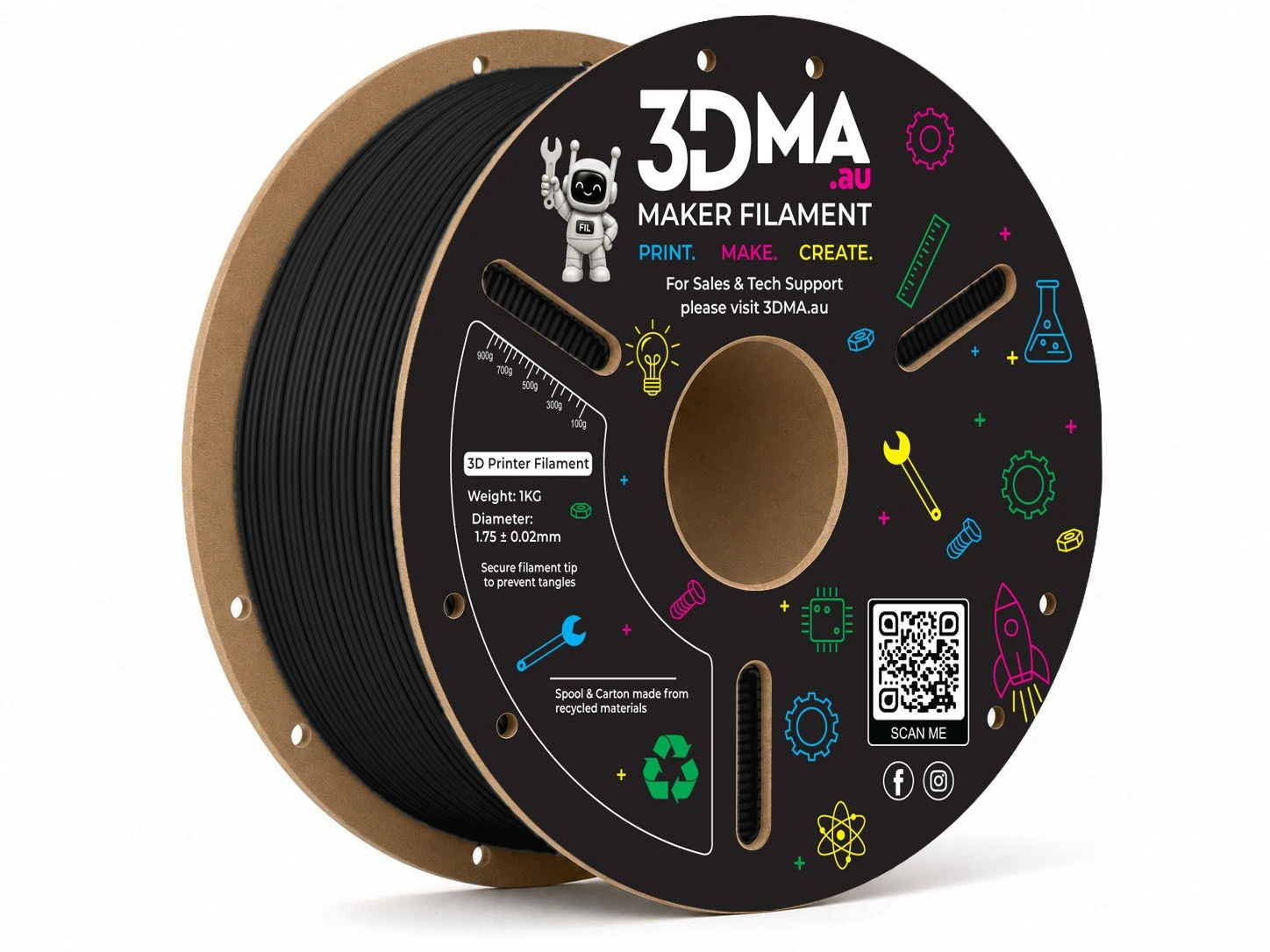
Ultra PLA+ High Flow is Core PLA’s tougher, faster sibling — a modified PLA that keeps up with high-speed printers while producing stronger, less brittle parts. All the easy printing of PLA, with the durability functional prints need.
Printing & drying
- Material
- PLA+
- Diameter
- 1.75 mm
- Spool
- 1 kg net
- Nozzle
- 200–230°C
- Bed
- 35–65°C
- Printing speed
- < 600 mm/s
- Part cooling
- High
- Enclosure
- Not required
- Nozzle type
- Standard brass
- Drying
- 50 ± 5°C for 8h
These are typical working ranges for orientation. The label on the spool you receive is authoritative for that batch. More detail in the storage and drying guide and the troubleshooting guide.
Shipping
- Packed and dispatched from Sydney, Australia.
- Every spool ships sealed with desiccant.
- Tracking is provided on every order.
- Buying more than a few spools? Bulk Orders gets you a quote and a supply plan.
Current delivery timeframes are on the Shipping & Returns page.
Returns & warranty
- Backed by the Australian Consumer Law.
- Spool faults are a product fault, not a settings problem. Contact us with your order number and photos.
- Not sure whether it is the spool or the printer? The five-minute triage tells you which half is at fault.
Full terms on the Shipping & Returns page.
Material details
Ultra PLA+ High Flow is Core PLA’s faster, tougher sibling. Impact modifiers lift its impact strength to 50.4 ± 2.8 kJ/m² and the melt is reformulated to run at up to 600 mm/s — twice the published speed of standard PLA. It still prints at PLA temperatures on an open printer with a brass nozzle, which is what makes it the easy upgrade rather than a different material to learn.
What Ultra PLA+ High Flow is good for
PLA+ is what you reach for when a part needs to be handled rather than looked at, and you do not want to move to PETG to get there. It keeps everything that makes PLA forgiving — low temperatures, minimal warping, no enclosure, excellent surface finish — and spends the difference on toughness and throughput.
How Ultra PLA+ High Flow prints
The manufacturer’s published window is a nozzle at 200–230 °C and a bed at 35–65 °C with adhesive, at speeds up to 600 mm/s. It runs a touch hotter than standard PLA at the bottom of the range, and at genuinely high speeds you want the nozzle near the top of it so the melt keeps up with the flow rate. Otherwise it behaves exactly like Core PLA: high part cooling, no enclosure, standard brass nozzle.
Printing at 600 mm/s is a property of the printer as much as the filament. On a machine with the acceleration and hotend to use it, this material will not be the limiting factor. On an older printer it simply behaves as a tougher PLA, which is reason enough to buy it.
What Ultra PLA+ High Flow will not do
Read this before you buy it for the wrong job
PLA+ is still PLA where heat is concerned. Its heat deflection temperature of 57 °C and Vicat softening point of 62 °C are identical to Core PLA’s, so a part on a dashboard on a hot Australian day sags exactly the same way. The toughness modifiers change how it breaks, not where it can live.
It also has no meaningful UV resistance, so outdoor parts chalk and embrittle over a season. And the extra toughness costs a little tensile strength and stiffness against plain PLA — 39 MPa against 38 is a wash, but if what you need is maximum rigidity, PLA-CF is stiffer by a distance.
If any of those apply, the material you want is elsewhere in the range:
- PETG — heat & real toughness
- ASA — Australian sun
- PLA-CF — maximum stiffness
- Core PLA — cheaper, same ease
PLA vs PLA+ goes through the difference with the published numbers, and the Materials Guide sets the whole range side by side.
Every colour, one material
Every colour of this PLA+ filament is the same polymer with the same settings — only the pigment changes. A profile tuned for one colour carries straight across to the next, and a multi-colour print does not need per-colour handling. Each colour is its own tile in the store, so what you click is what arrives.
Printer compatibility
Ultra PLA+ High Flow is 1.75mm 3D printer filament on a standard 1 kg spool, so it runs on any FDM printer that takes 1.75 mm — Bambu Lab, Prusa, Creality, Elegoo, Anycubic and the rest. Standard brass nozzle, no hardware change, and it feeds through an AMS or other multi-material unit like any unfilled PLA. The spool label states a diameter tolerance of ±0.02 mm, and the filament tip is secured before packing so the spool does not tangle mid-print.
- Bambu Lab
- Prusa
- Creality
- Elegoo
- Anycubic
- Sovol
- Any 1.75 mm FDM printer
Storage, drying and shelf life
PLA+ absorbs moisture at about the rate plain PLA does — slowly, but a humid east-coast summer gets there. Wet filament pops at the nozzle, strings across gaps, and prints a rough, furry surface. At high speeds it shows up sooner, because a damp melt cannot keep up with the flow rate.
Every spool ships sealed with desiccant. Keep it that way between prints and drying will not come up. If a spool has been open on the shelf through a wet season, the manufacturer’s figure is 50 ± 5 °C for 8 hours in a dryer or blast oven, with storage below 20% relative humidity. The storage and drying guide covers what that looks like in practice.
Technical specifications
Preparation Before Printing
- Drying settings (blast drying oven)
- 50 ± 5 °C for 8h
- Printing & storage humidity
- ≤ 20% RH (Sealed with Desiccant)
Recommended Printing Settings
- Nozzle temperature
- 200 - 230 °C
- Bed temperature (with glue)
- 35 - 65 °C
- Printing speed
- < 600 mm/s
Physical Properties
- Density
- 1.23 g/cm³
- Melt index
- 10.7 ± 1.5 g/10 min
- Melting temperature
- 160 °C
- Vicat softening temperature
- 62 °C
- Heat deflection temperature
- 57 °C
Mechanical Properties
- Tensile strength
- 39 ± 2 MPa
- Elongation at break
- 8.5% ± 1.2%
- Bending strength
- 71 ± 6 MPa
- Bending modulus
- 2846 ± 175 MPa
- Impact strength
- 50.4 ± 2.8 kJ/m²
Manufacturer figures for Hyper PLA+, from PLA Series Parameters. Test values are measured on standard samples and are for design comparison — real-world results depend on your printer, settings and model.
Common questions about Ultra PLA+ High Flow
What is the difference between PLA and PLA+?
Impact modifiers. On the published figures, PLA+ is not stronger in tension — 39 MPa against Core PLA’s 38 — but it is formulated to fail differently, flexing a little before it gives rather than snapping cleanly. Where this one differs most is speed: up to 600 mm/s against 300 for standard PLA. PLA vs PLA+ covers the comparison properly.
Do I need a fast printer to use it?
No. On an older or slower machine it prints exactly like PLA and you simply get the toughness. The High Flow formulation removes a ceiling rather than imposing a floor.
Is PLA+ more heat resistant than PLA?
No. Heat deflection at 57 °C and Vicat softening at 62 °C are the same as Core PLA’s. If the part gets hot — a car interior, a sunny windowsill, anything near an appliance — you need PETG at 72 °C or ASA at 99.
Should I just use PLA+ for everything instead of PLA?
For functional parts, it is the better default. For models, miniatures and anything decorative, Core PLA is cheaper, prints just as easily and has a slightly better surface. The toughness is worth paying for when something will be handled.
Will PLA+ work with my printer?
If your printer takes 1.75 mm filament, yes. That covers Bambu Lab, Prusa, Creality, Elegoo, Anycubic, Sovol and effectively every current desktop FDM machine. No firmware change, no hardware swap, standard brass nozzle.
How much can I print from a 1 kg spool?
At PLA+’s density of 1.23 g/cm³, a 1 kg spool of 1.75 mm filament holds roughly 340 metres — marginally more than Core PLA, because the modified polymer is slightly less dense.
Is PLA+ tough enough to replace PETG?
Not quite. PETG’s impact strength of 67.6 kJ/m² still beats PLA+’s 50.4, and PETG holds its shape 15 °C hotter. What PLA+ gives you is most of the toughness with none of PETG’s stringing, bed-adhesion quirks or cooling fussiness — a sensible middle ground for indoor functional parts.
Reviews
There are no reviews yet.